
👋 Hey, Nick here. A big welcome to the new subscribers from BlackRock, StepStone, and CIFC Asset Management. You’re now one of the 3,262 subscribers, and you’re reading the 179th edition of my private credit newsletter.
Reading on Outlook? The charts won’t render. Read it online
📕 Reads of the Week
Our industry is increasingly K-shaped, and most of the external focus is going to be on the unhappy part of the K. We find ourselves on the happy part of the K, and that's what's showing up in the numbers.
Market Updates
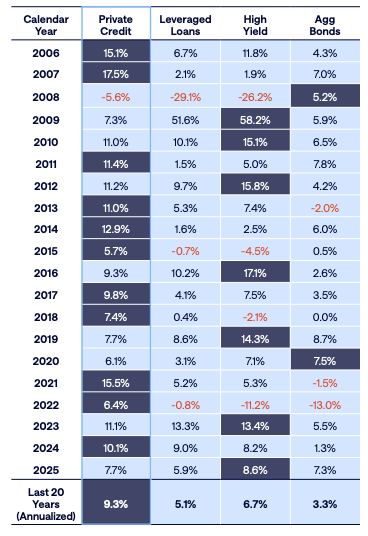
Ares: Private credit’s returns have outperformed leveraged loans in 16 of the past 20 years. Link
The Federal Reserve Bank of New York launched a U.S. direct lending survey. Participation will be voluntary, and participant criteria is available here.
Manager & LP Updates
BlackRock sold half of its BDC’s debt portfolio to a continuation vehicle backed by Pantheon. Link
Read Accredited Investor Insights post for the full breakdown.
HPS led a £550m financing to Aston Martin secured against its branding and naming rights. Bondholders threatened legal action, believing Aston Martin had moved assets out of their pool of collateral. Link
Jane Street is looking to refinance $11 billion of existing public-market debt into a large private credit facility. The transaction would replace its current mix of bonds and syndicated loans with private credit provided by a small group of lenders, reportedly including Pimco. The move would give Jane Street more flexibility over its capital structure, potentially provide additional funding for trading and AI, and reduce the amount of financial information it has to disclose to a broad group of public bond investors. Link
Brookfield: How specialization can provide an investment edge in private credit. Link
Apollo: The AI Buildout Is Reshaping Credit Markets
Apollo published its take on how private credit can support the AI buildout alongside public markets. See my key takeaways below
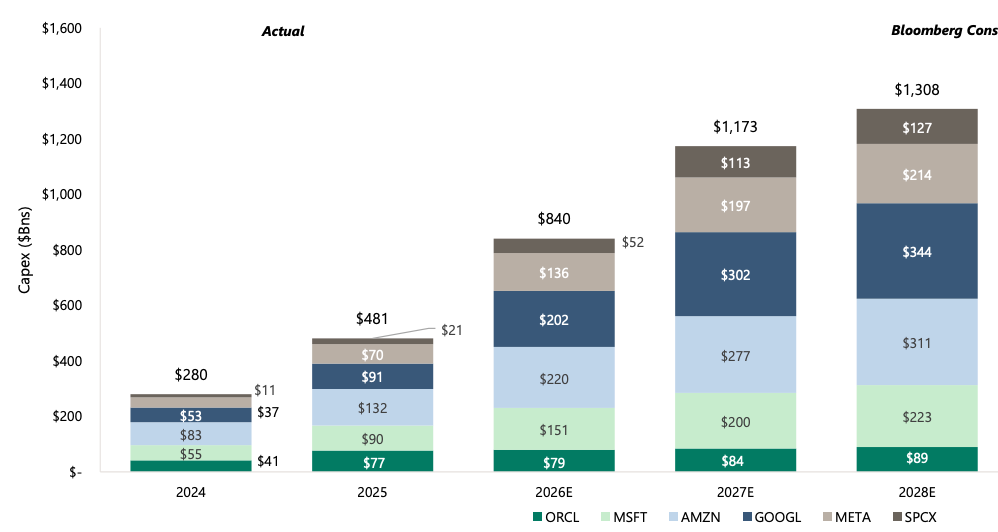
Hyperscaler Annual Capex Could Exceed $1 trillion in 2027
Unlike previous technology cycles, which were largely asset-light and financed through venture capital, public equity, and internal free cash flow, AI requires sustained investment in chips, servers, data centers, and power.
Hyperscalers will account for a large share of this spending, but they will not finance the buildout alone.
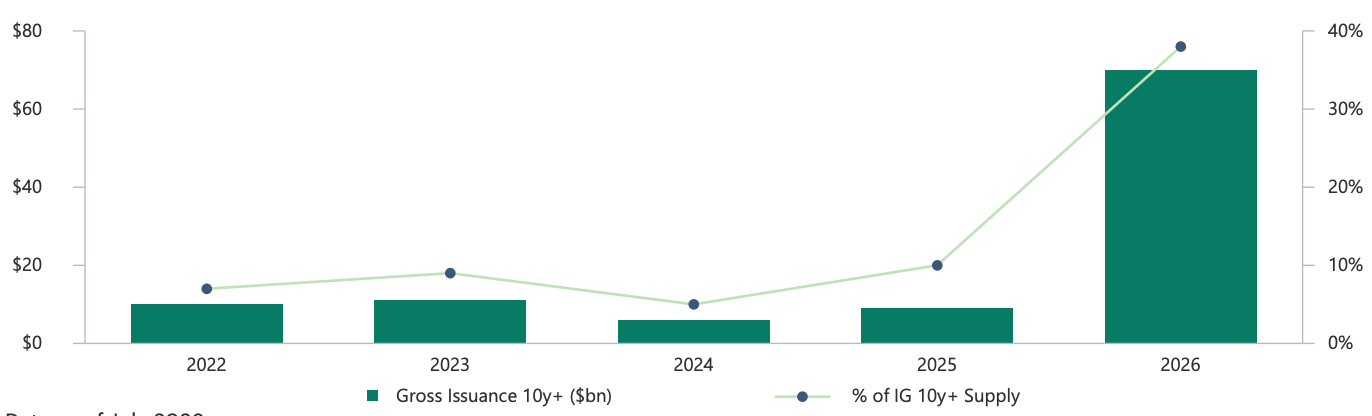
AI-related debt accounts for nearly 40% of longer-duration bond supply
Strong operating cash flow will fund a meaningful portion of this investment, but not all of it. No single financing market will be large enough to meet these needs. Apollo expects Public IG to finance only a fraction of the capital required.
Amazon, Alphabet, SpaceX, Meta, Oracle, and Nvidia have issued about $220 billion of debt this year alone.
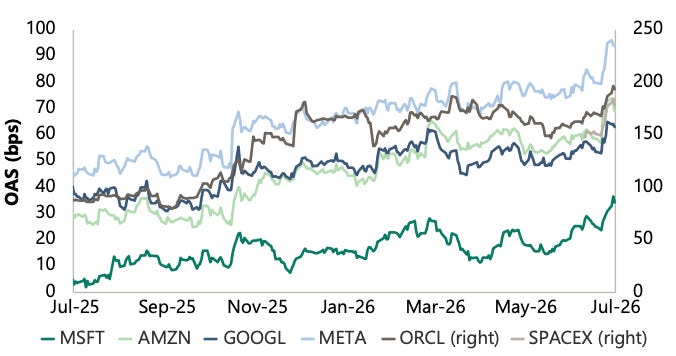
Hyperscaler spreads have more than doubled since the middle of 2025
New issues have required greater price concessions, and several long-dated transactions have widened meaningfully since issuance.
Apollo views this as a supply-driven repricing rather than a sign of weaker credit fundamentals.
Public markets are being asked to absorb an unusually large volume of long-dated issuance from a relatively small group of borrowers.
Public IG Capacity Is Constrained by Concentration and Ratings
Hyperscalers are already becoming significant components of IG benchmarks. Additional borrowing would increase both single-name and sector concentration.
Ratings may provide another constraint. Although some issuers could borrow substantially more while remaining below 2x leverage, doing so could result in multiple-notch downgrades, increasing financing costs, and reducing demand from ratings-sensitive investors.
The gap between fundamental borrowing capacity and public-market capacity creates a substantial role for private credit.
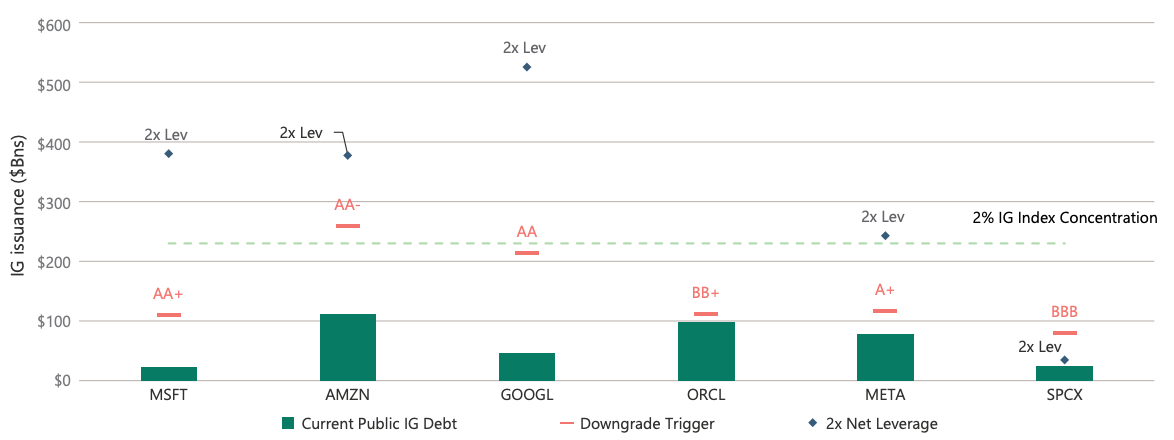
The existing AI ecosystem could support more than $2 trillion of additional IG debt
Public IG markets may be able to absorb less than $1 trillion through 2030
The gap between borrower capacity and public-market capacity creates a substantial role for private credit
Private IG will likely provide more than $1 trillion of this financing
👉 Learn more in Apollo’s Mid-Year Outlook Report
Pitchbook US Private Credit Monitor
YTD volume and deal count are tracking behind last year’s pace
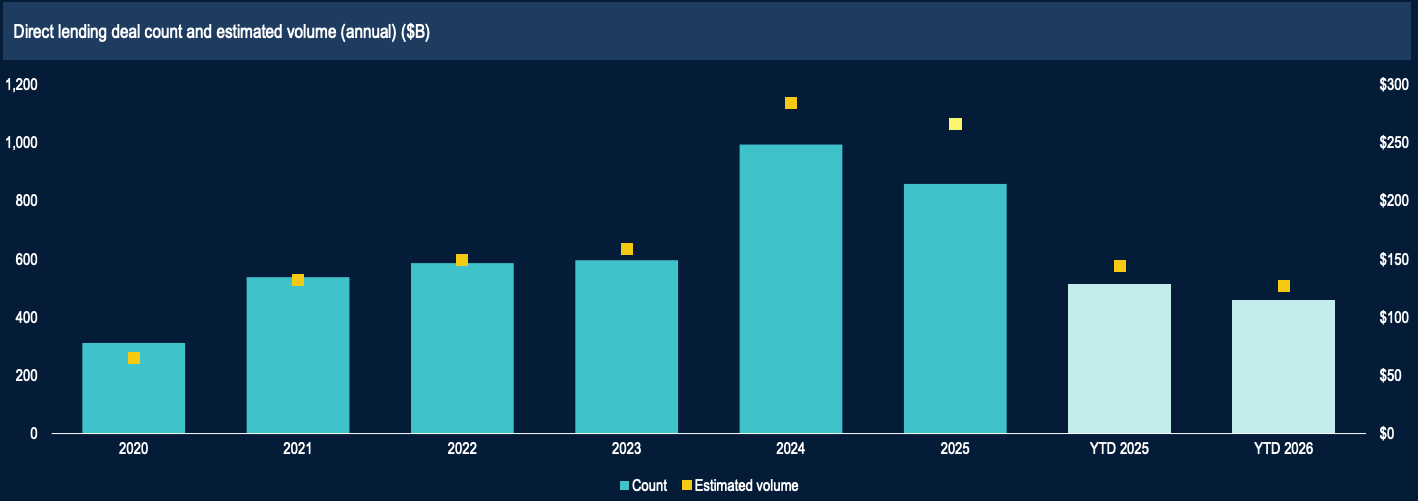
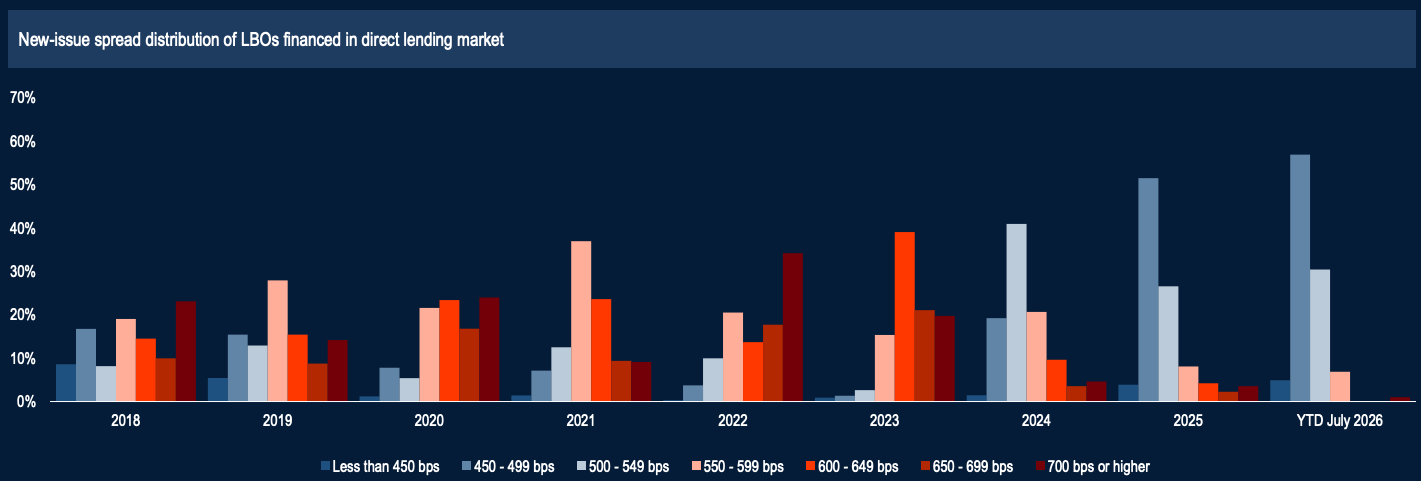
Spreads are up 5% YoY. The 450–499 bps range dominates the new-issue LBO spread distribution
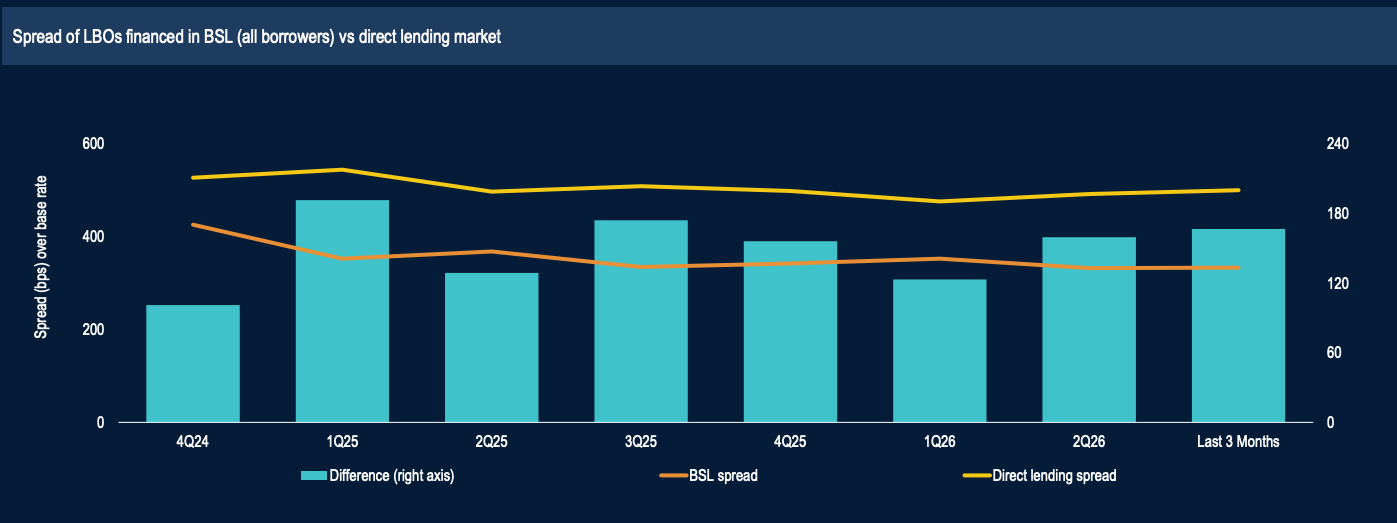
The BSL - direct lending spread gap widened to 166 bps, up 7 bps from Q2
👉Read Pitchbook US, Private Credit Monitor
💰Fundraising News
Bridgepoint’s $5.9bn Direct Lending IV
Bridgepoint, a London-based asset manager, raised $5.9 billion for the final close of Bridgepoint Direct Lending IV. The fund senior loans to mid-market companies across Europe. It is already more than 40 percent invested across over 20 borrowers.
👉 Private Equity Wire Announcement
Comvest’s $5.4bn Fund VII
Comvest Credit Partners, a West Palm Beach-based direct lender, announced a final close of $5.4 billion for its Credit Partners VII. The fund invests across both cash flow and asset-based lending opportunities for sponsored and non-sponsored middle-market companies, allocating between the two as relative value shifts. It is the largest raise in the platform’s history and the first since the manager was acquired by Manulife.
Willow Tree Credit Partners’ $730m Continuation Fund
Willow Tree Credit Partners, a New York-based direct lender, closed a $730 million private credit continuation vehicle led by HarbourVest Partners. The vehicle holds a portfolio of approximately 130 positions, primarily first lien loans to sponsor-backed companies, moved out of Willow Tree Fund II, a late 2020 and early 2021 vintage. Existing limited partners were given the option to take liquidity or roll their exposure into the new vehicle. Evercore advised on the transaction.
LGT Capital Partners Secondary Fund Launch
LGT Capital Partners, a Switzerland-based private markets manager, launched its debut credit secondaries strategy. The strategy will invest in LP-led, GP-led, and opportunistic transactions with an emphasis on senior lending. LGT manages more than $5 billion of private credit assets on behalf of the LGT endowment and external clients, spanning direct lending, bank loans, NAV loans, structured credit, subordinated lending, and specialty finance.
Macquarie AM’s Infra Credit BDC
Macquarie Asset Management, a Sydney-based asset manager, launched its Infrastructure Income Opportunities BDC. Target sectors include transportation leasing platforms, specialist environmental and waste services, energy transition assets such as battery storage, education facilities, and emergency services.
Vistara Growth’s Structured Opportunities Fund
Vistara Growth, a Vancouver-based technology lender, launched the Vistara Growth Structured Opportunities Fund with a $500 million target, anchored by Beedie Capital with a commitment of up to $125 million. The evergreen fund provides growth debt and equity capital to mid to later stage technology companies across North America. Beedie Capital has simultaneously acquired a 50 percent ownership stake in Vistara, having been one of its first limited partners in 2015.
This newsletter is for educational and entertainment purposes only. It should not be taken as investment advice.