
👋 Hey, Nick here. A big welcome to the new subscribers from AIMCo, Partners Group and TPG. You’re now part of a select group of 2,822 subscribers. This is the 163rd edition of my private credit newsletter.
If you’re reading this on Outlook, most of the graphs won’t show. I’d recommend you read it online
I would not underestimate the kind of creativity that shows up when fees are on the line.
📕 Reads of the Week
Market Updates
Golub: U.S. Middle Market Remained Resilient in Q1 2026. Link
Brookfield: Why real asset lending is built for today’s environment. Link
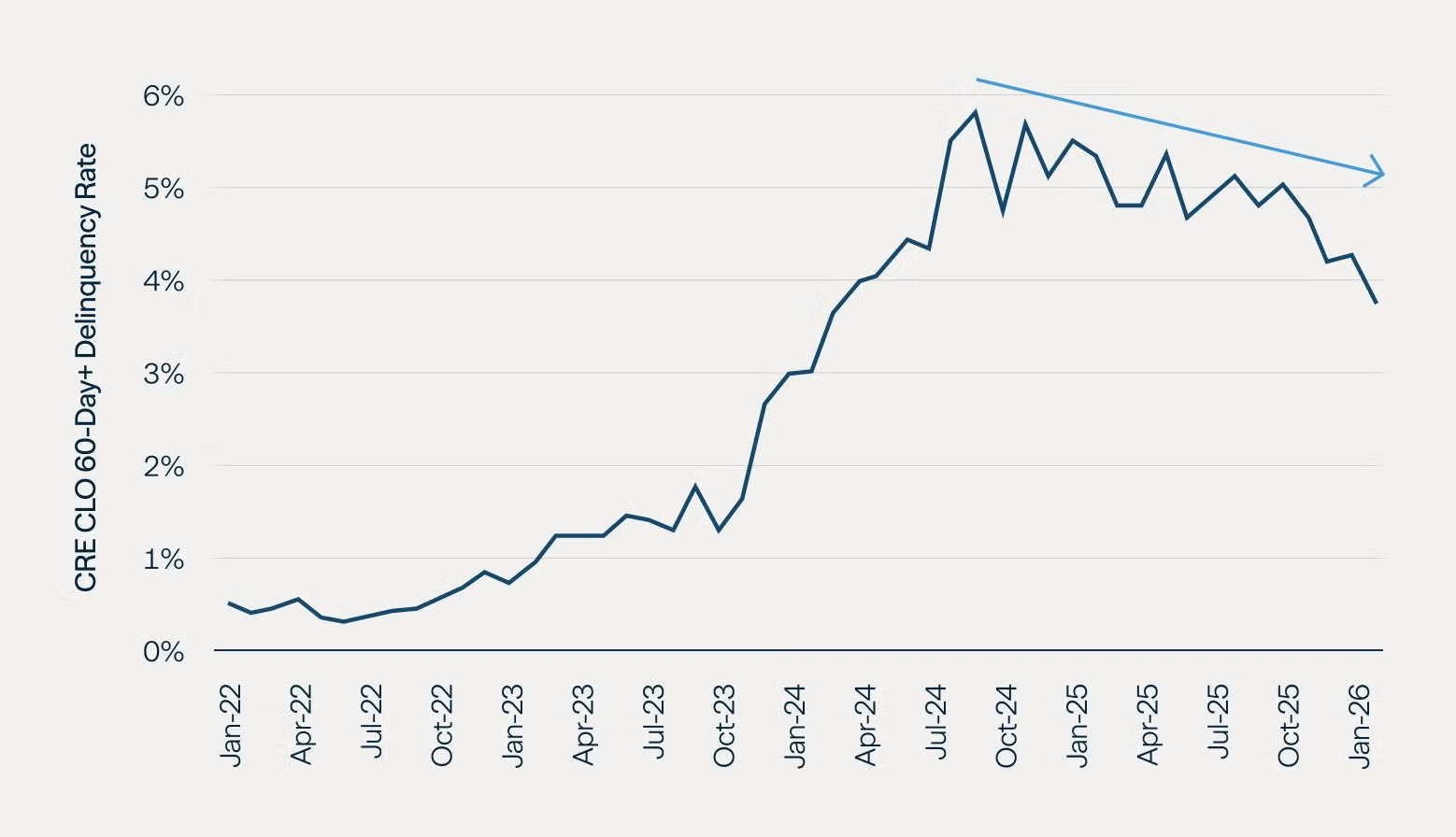
Real Estate Credit Delinquencies Well Off the Highs
Manager Updates
Nest, the largest UK workplace pension scheme, awarded Crescent Capital £450 million as part of a new direct lending mandate. Crescent will originate senior secured loans directly to US middle market companies. Nest’s plans to allocate up to 30% of its AUM to private markets by 2030. Link
Blue Owl recorded its strongest share price performance since late 2022. The firm’s stock climbed roughly 17% over two days. Link
Sycamore Tree Capital Launches Credit Secondaries Investment Platform. Link
“Soccer” Special
Eagle Point provides a $50 million “asset-backed” loan to Sports Illustrated secured against World Cup tickets. The loan has a 100% LTV and targets mid-teens returns.
“Normally you would never lend at 100 per cent…
But World Cup tickets are typically worth up to three times their face value, so the reality is that we are lending at a 35 per cent loan-to-value ratio…
Of all the things I’m worried about, World Cup tickets selling below face value isn’t one of them.”
Thomas Majewski, founder and managing partner of Eagle Point
Analysis of Ares Management’s $500 million investment in Chelsea Football Club.
The element that poses the greatest existential risk to the Chelsea Football Club ownership structure is its PIK mechanism.
At an annual compounding rate of roughly 12% to 13%, the initial £410.2 million principal will double in approximately six years.
If no cash repayments are initiated before the August 2033 maturity date, the total cost required to service, satisfy, and retire the preferred equity agreement will vastly exceed £850 million.
Partnership Updates
Sumitomo Mitsui Financial Group and Nippon Life Insurance are in discussions toward launching a $3 billion private credit partnership. Link
BDC / Interval Fund Updates
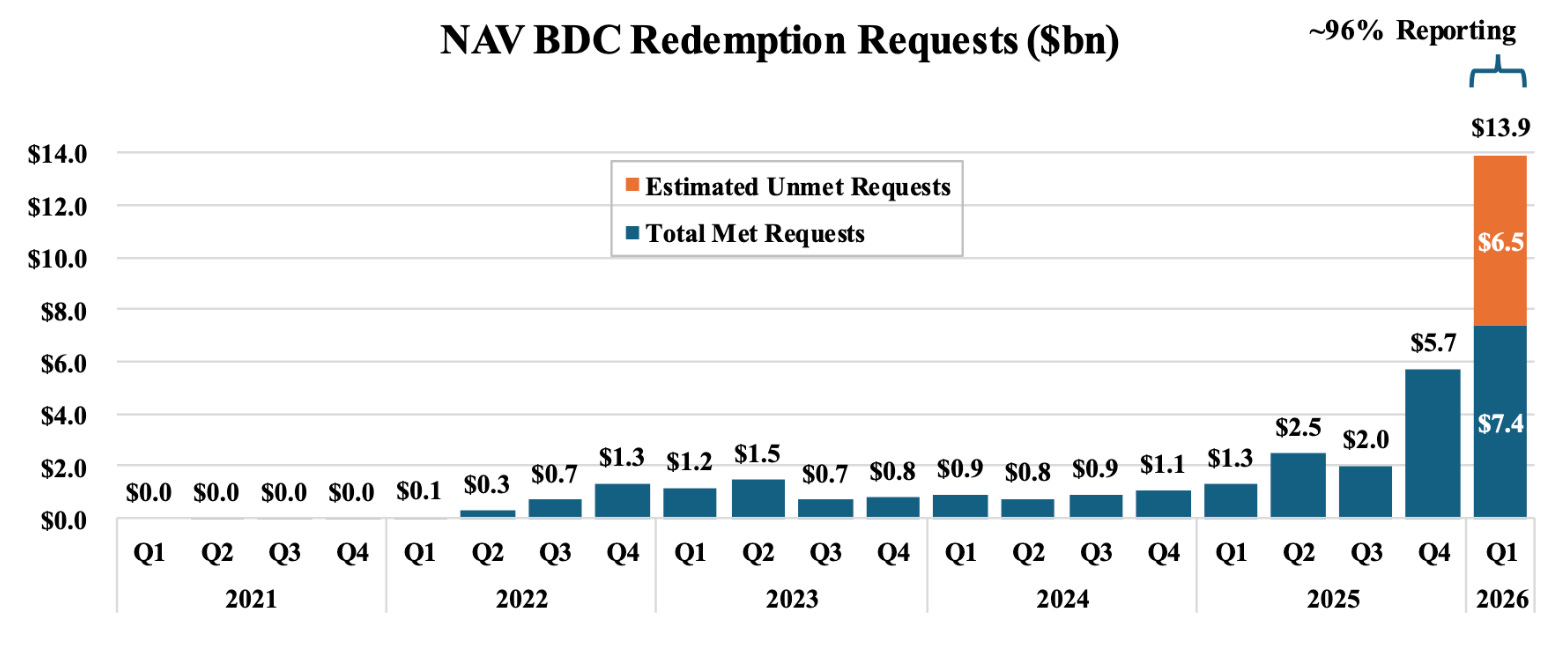
NAV BDC sponsors have returned more than $7.4 billion to investors in Q1
Blue Owl Capital Corporation II declared a Q2 distribution of 5% of NAV. Following this, OBDC II will have returned 35% of NAV since March 2025. Link
Goldman Sachs Nontraded BDC raised a $750 million bond. Link
JPMorgan: Today’s elevated redemption requests appear to be driven more by sentiment than a broad-based deterioration in market fundamentals because credit fundamentals remain resilient. Link
Ares: Let’s talk about the F word.
Ares in the Gaps is out, and as always, it’s worth reading in full (Link).
My highlight is the section on fraud, below with a few excerpts.
Recent reports of fraud in the market have left many with the impression that fraud can happen anytime, anywhere, to anyone...
And there’s precious little you can do about it.
That is just not true.
Fraud in financial markets is nothing new, neither are the means by which fraud is carried out. Fraud is a crime of opportunity. In that sense, fraud is not much different from home burglary, and neither are the perpetrators. Vulnerabilities and gaps in security are identified, often cultivated, and ultimately exploited.
Most victims don’t realize they are as vulnerable as they are.
Mitigating fraud is largely about minimizing both the means and opportunity.
Because one can’t fully eliminate the risk, it’s also about detecting it as quickly as possible. It’s about
Locking the front door,
Installing security cameras and alarm systems
Placing a trained guard dog in the house for good measure.
It’s also about avoiding the neighbourhoods known for such crimes.
There are certain sectors in the ABF market that almost inherently create both means and opportunity for would-be fraudsters. Trade finance, high-rate consumer lending, life settlements and many corners within litigation finance. These sectors have intrinsic features that inhibit or prevent investors from mitigating fraud risk.
Consequently, they tend to be bad neighborhoods.
There exists a set of best practices and minimum standards.
They are borne of the market’s experience with previous fraudsters.
What follows is a list of many of these standards and best practices, and some very brief observations. These standards and practices are well known across the ABF market.
👉Read the standards and best practises here
When consistently employed, they are effective at identifying vulnerabilities, means and opportunity.
💰Fundraising News
Adams Street Partners, a Chicago-based manager, closed its $7.5 billion Private Credit III fund. The fund provides senior financing to sponsor-backed middle-market companies. PC III’s existing portfolio has a loan-to-value ratio below 40% and an average debt multiple of ~5x. More here
StepStone closed a $3.1 billion structured solutions vehicle for private market secondaries. Ares Management Alternative Credit will serve as the primary capital provider to the vehicle, with Barings Portfolio Finance providing a substantial portion of the vehicle's rated financing. More here
Comvest Partners, a Florida-based manager, rasied $2.6 billion for its Credit Partners VII. The strategy provides senior secured loans to US mid-market companies, with the ability to do transactions as large as $300 million. The invests in sponsored and non-sponsored businesses within target industries that include healthcare services, financial services, speciality finance, business and technology services, consumer and retail, and industrials. More here and here.
CapitaLand, a Singapore-based manager, closed its $320 million Asia Pacific Credit Program II. The fund invests in senior secured real estate credit across Asia Pacific. More here
This newsletter is for educational and entertainment purposes only. It should not be taken as investment advice.