
👋 Hey, Nick here. A big welcome to the new subscribers from Deutsche Credit, Hanover Square Partners, and the US Department of the Treasury. You’re now one of the 3,472 subscribers, and you’re reading the 186th edition of my private credit newsletter.
Last week’s In The Gaps Newsletter is hands down the best thing I’ve read this year. If you’re short on time, you can read my highlights below, but I’d thoroughly recommend you read the full report here
Reading on Outlook? The charts won’t render. Read it online
📕 Reads of the Week
Market Updates
Pitchbook: $12 billion of direct-lending deals have been refinanced in the syndicated loan market so far this quarter, the highest amount since LCD began tracking this data in early 2022. Link
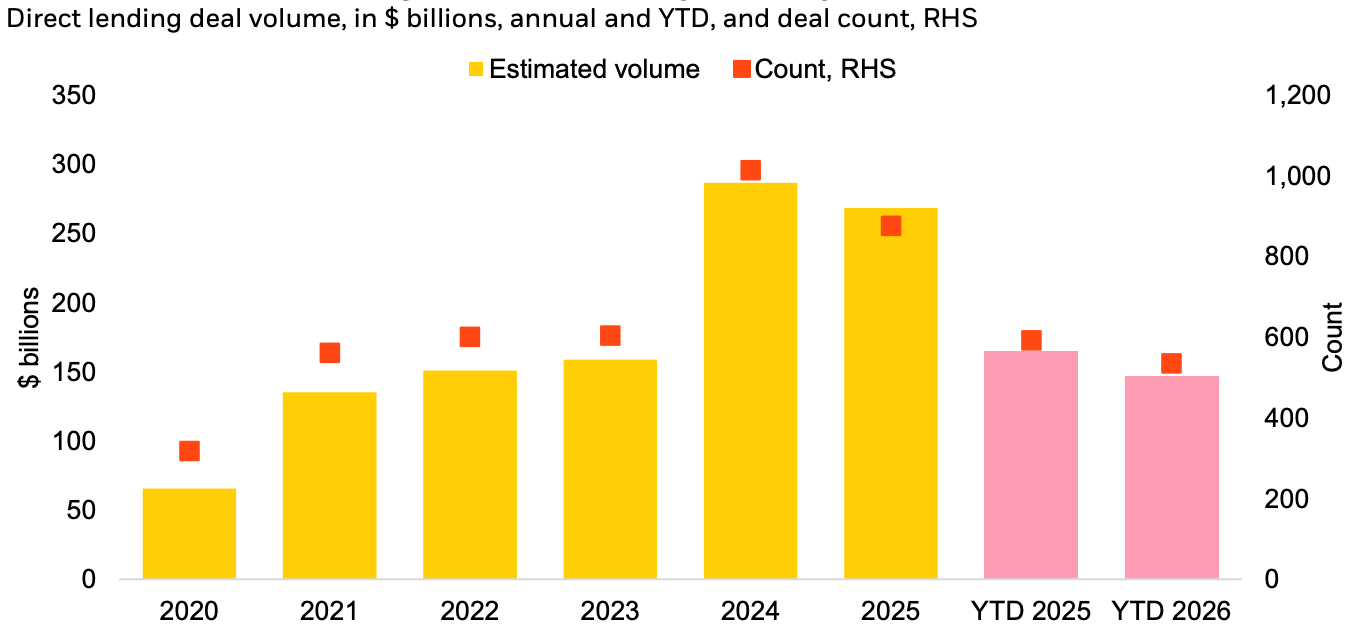
BlackRock: YTD direct lending deal volume is only modestly below 2025. Link
Manager Updates
Goldman Sachs is the lead bidder for $37bn credit manager Palmer Square. Palmer Square has built a substantial presence in CLOs, with its CLO platform representing around $27bn. An acquisition would give Goldman an opportunity to significantly increase its scale in the CLO market. Link
Partners Group is exploring a €800m private credit continuation vehicle. Link
Partnerships
Sixth Street announced a partnership with the UK bank Lloyds to provide funding for the UK’s commercial real estate sector. The agreement will allow Sixth Street’s global Asset Based Finance platform to provide financing solutions for UK property borrowers. Link
JPMorgan and Qatar Investment Authority are establishing a $5 billion partnership focused on providing senior financing to middle-market companies in the U.S. across sectors, with a focus on industrials, services, healthcare and technology. Link
Blackstone plans to set up a new insurance vehicle at Lloyd’s of London. Link
KKR and Doha Bank are exploring a partnership that will give Qatari investors access to KKR’s private markets strategies. Link
BDC Redemptions Q3 26 Update: Week 4
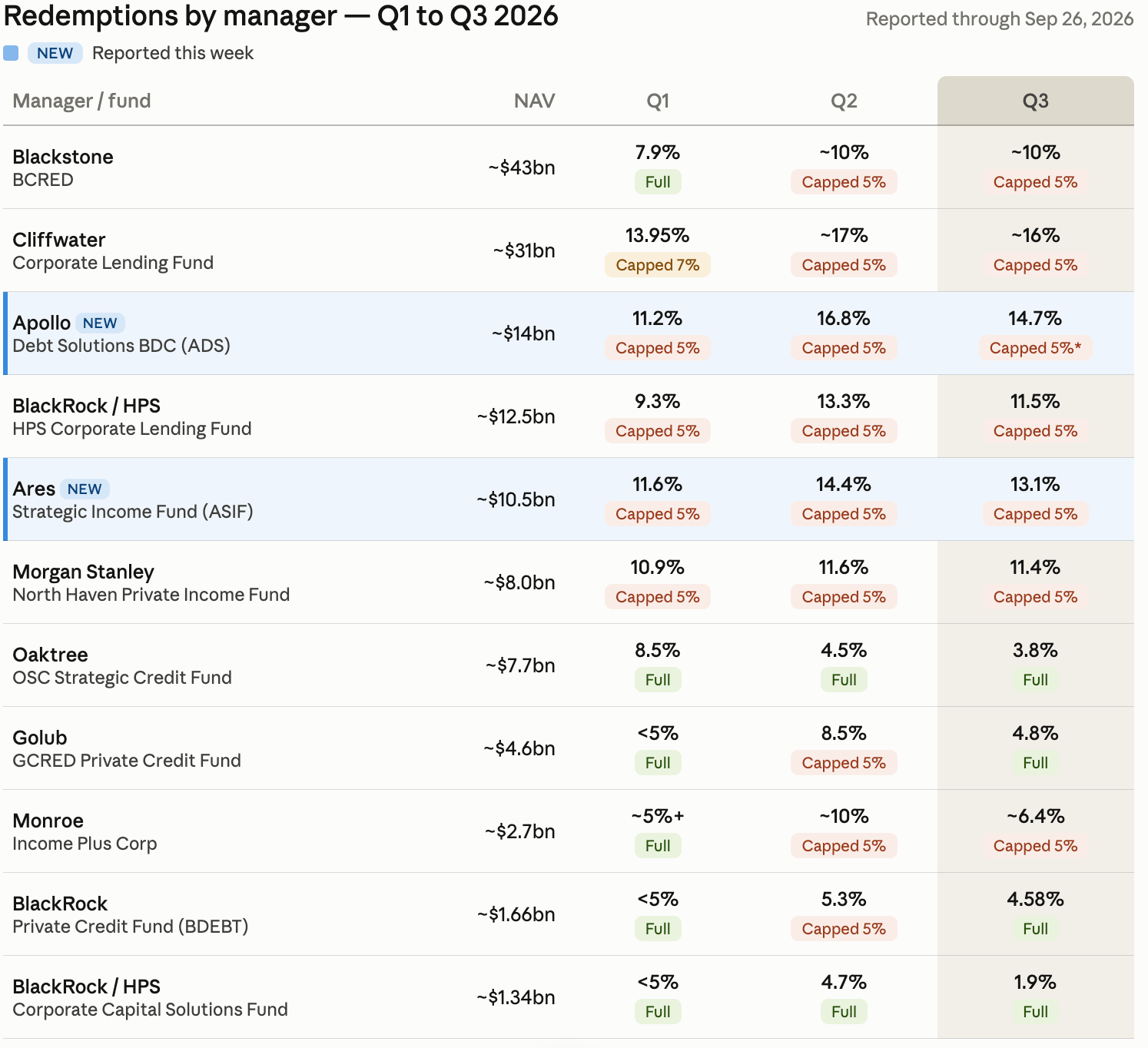
Last week saw Apollo and Ares announce Q3 redemptions:
Both managers received above-average redemption requests of 14.7% for Apollo and 13.1% for Ares.
Q3’s weighted average redemption request is 11.6%, down ~1 percentage point vs. last quarter.
Requests for both managers were lower than Q2. Apollo’s fell 2.1 percentage points, and Ares fell 1.3 percentage points.
Both managers capped redemptions at 5% above.
CONTEXT THE MEDIA MISSES: BDC redemptions are increasingly being presented as a read-through for the entire private credit market. If you step back, the data shows a different picture: redemptions remain well below total market fundraising.
I’ve tracked nearly $100 billion of private credit fundraising this quarter, more than six times the $16 billion redeemed from BDCs this quarter.
Ares on the Financial Engineering Behind the AI Boom
Before you skim my highlights, do yourself a favour and read the whole report. You’ll thank me later.
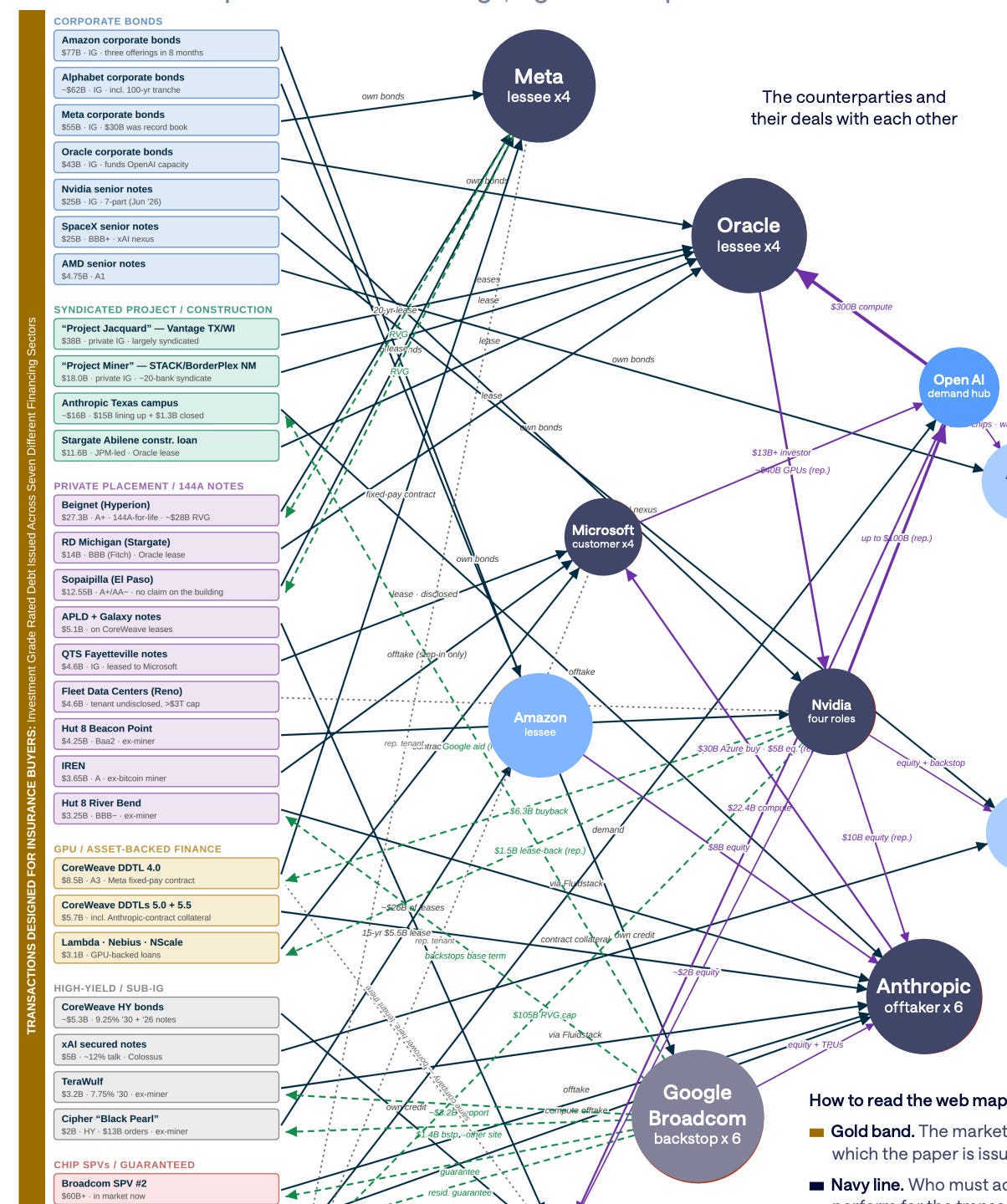
All of the risk converges on just eight names
Much has been made of the circular and interconnected relationships inside the AI, data center and chip markets.
Ares endeavored to add a dimension to that discussion by asking a narrower question:
“on a look-through basis, who is ultimately on the hook for all these financings?”
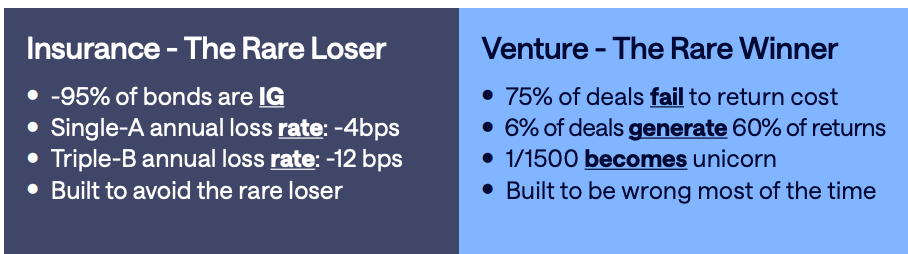
Venture capital may turn this into a potentially calamitous risk
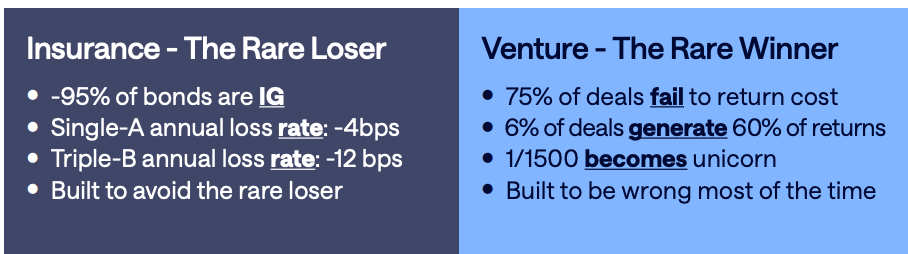
The people who run these companies, and the sponsors behind most of them, follow venture’s standard operating procedure: bet the farm, repeatedly.
What passes for a coherent, conventional way to build and scale a technology company is a very strange thing to find underneath a bond that an insurer bought to fund a retiree’s annuity, at an investment grade spread.
Insurance is looking to pick up 50-100 basis points of excess spread while venture is looking to make 50x to 100x on their money.
Is it debt or is it equity?
The sponsor can now borrow against its stake in the JV, typically funding 80–100% (usually 90%+) of its investment with debt. This debt is typically held by its affiliated insurer, serviced by the JV's dividends.
Because of the corporate guarantee, the debt can be rated at, or a notch below (often higher than), the corporate itself.
From a corporate perspective, the underlying instrument is engineered to behave like equity, while from a sponsor perspective the instrument is engineered to behave like debt.
At closing, the guarantee sits off the corporate's balance sheet; it is deemed a contingent liability, out-of-the-money, and not yet "probable." So corporate leverage ratios and the rating are untouched. Its existing lenders and shareholders enjoy the benefits of an equity label.
Moody's counts roughly $662 billion of aggregate data center leases that Amazon, Meta, Alphabet, Microsoft and Oracle have signed but not yet commenced as commitments that do not yet appear as debt because the service has not been delivered to trigger the liability. That liability is larger than the five firms' entire adjusted debt, and their total future lease commitments run to nearly a trillion.
Securitization is like fertilizer. You can grow tomatoes or blow up buildings
Under normal, base case scenarios, both of the investments (corporate and JV) can appear as perfectly sound investments.
Each is engineered to be resilient along the risk axis for which it was designed: the corporate’s leverage or the sponsor’s credit rating.
Each, however, possesses a critically important risk factor that sits quietly off to the side. When that risk triggers, equity becomes debt, or debt becomes equity…
The consequences can be very material. For insurance balance sheets which are typically levered 12:1 (or more), the designation of debt (vs. equity) has major consequences from a capital perspective.
Sitting in an investment committee meeting should never feel like sitting at a poker table. Serious credit investing involves knowing exactly what you are holding (as collateral, rights, controls, protections, etc.), and knowing that it’s a winning hand to a high degree of certainty because you know what everyone else is holding.
Should all of this enthusiasm cool - what, exactly, would we be holding?
In one case, the equity was really debt; in the other, the debt was really equity. The support did its job. It simply protected a different party than the label implied, and the other side paid for it
Creditors in this system are left holding a single purpose building that has been rejected by one of the very few hyperscalers who would lease it, sitting in a special-purpose vehicle, levered by insurance capital, carried at a residual value that has never been tested in a downturn.
Decomposing AI capex spend

Silicon is different. It is not only one of the fastest-depreciating assets we can name, but the financing market behind it is also developing so quickly that it will soon become its own asset class.
Said differently, the majority of the dollars that will be used to finance the forthcoming and massive capex build-out will capitalize the asset with the lowest potential recovery or residual value in a downturn, and is one with which financing markets have the shortest track record and least experience.
What is a GPU worth if you have to sell it? Less than you paid, and less every quarter.
💰Fundraising News
Cheyne Capital’s $4bn European Real Estate IX
Cheyne Capital, a London-based credit manager, closed its $4 billion European Real Estate Credit Holdings IX. The fund lends against hotels, offices, student accommodation, residential and mixed-use properties across Belgium, France, Ireland, Italy, Portugal, Spain, Sweden and the UK. More than half of committed capital has already been deployed across 73 underlying loans.
PCCP $2.3bn Real Estate Credit XI.
PCCP, a Los Angeles-based real estate manager, closed its $2.3 billion Credit XI. The fund focuses on U.S. middle market investments across the four traditional property sectors: residential for rent, industrial, retail, and office.
Goldman Sachs’ $10bn Evergreen European private credit
Goldman Sachs Alternatives, a New York-based asset manager, surpassed $10 billion in total assets for its evergreen European private credit strategy. The strategy finances European mid-market companies under a buy-and-hold approach. The portfolio now has exposure to more than 400 companies, including private credit loans to over 100 firms.
KKR’s $350m Equipment Finance Platform
KKR launched Akrapoint Commercial Capital, a Denver-based equipment finance platform. KKR committed $350 million through its Asset-Based Finance strategy. The platform will finance vocational assets, specialty trailers, and industrial equipment for small and middle-market businesses across US manufacturing, energy, sanitation, construction and transportation sectors.
Blackstone Private Markets Fund
Blackstone launched its Private Markets Fund, a new perpetual strategy giving eligible non-US investors access to private equity, infrastructure, real estate and credit through a single allocation.
Aegon AM’s Insurance Credit Fund
Aegon Asset Management, a Netherlands-based asset manager, launched its Insured Credit Fund. The evergreen strategy is for institutional investors in the UK and Europe. The fund invests in private credit globally, with underlying loans insured by insurers carrying A or AA ratings to transfer credit risk away from the borrower toward the insurer.
Enercon Wind Farm Financing
Enercon, a Germany-based wind turbine manufacturer, launched the Enercon Finance Solutions Fund to provide mezzanine financing for new and existing wind farm projects. The fund offers mezzanine loans of up to 10 million euros per project, reducing operators’ equity contributions while letting them retain ownership and control of their projects. The fund is anchored by MEAG, the asset manager of Munich Re Group.
This newsletter is for educational and entertainment purposes only. It should not be taken as investment advice.