
👋 Hey, Nick here. A big welcome to the new subscribers from Eurazeo, Churchill, and Selinca. You’re now one of the 3,584 subscribers, and you’re reading the 190th edition of my private credit newsletter.
Reading on Outlook? The charts won’t render. Read it online
📕 Reads of the Week
“Investors who requested a redemption in each of these two quarters received 75% of their capital back in about 90 days.
Another illustration of the semi-liquid structure working as designed.”
Market Updates
Only 1% of UK Default Pensions are in Private Credit
ABI and Pensions UK released the first progress update on the UK’s Mansion House Accord.
Private credit exposure is £3.6bn of £22.1bn in private markets, less than half of property’s £8.3bn.
Insurers see private credit an emerging growth area, alongside infrastructure and real estate.
Consultants’ focus on fees vs. returns is the biggest barrier to more private-market investment.
The Mansion House Accord is a voluntary pledge by 17 of the largest UK pension providers to put 10% of default 401(k)-style savings into private markets, half of it in Britain, by 2030. The UK government encouraged it to boost domestic investment and saver returns.
Most investors expect defaults to rise in the next six months
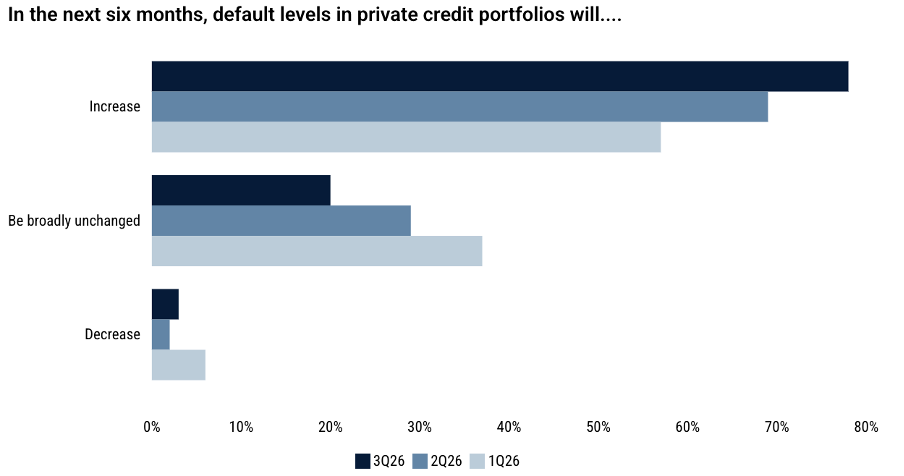
👉 PitchBook: Global Private Credit Survey
Manager Updates
Ares: The Allocator’s Playbook for Private Market Due Diligence. Link
Blackstone reported $35.8bn of inflows into Credit & Insurance taking the division’s AUM to $480bn, up 11% year-on-year. Total firmwide AUM reached approximately $1.37tn. Blackstone Q3 Earnings
Golub Middle Market Report: U.S. Middle Market Earnings Grew 7% in Q3 2026. Link
Partners Group raised $510 million from a group of US-based insurance companies for its second rated feeder vehicle of 2026. The vehicle enables the insurers to invest in Partners Group’s evergreen private credit strategy while benefiting from immediate capital efficiency, due to the fully paid-in nature of evergreen funds, as well as reduced capital charges. Link
Partnership Updates
Carlyle partnered with Basic Capital, the technology-driven retirement platform to bring Carlyle’s private markets investment strategies to 401(k) and other defined contribution plans. The firms will create several collective investment trusts that will be available on Basic Capital’s open-architecture platform. Link
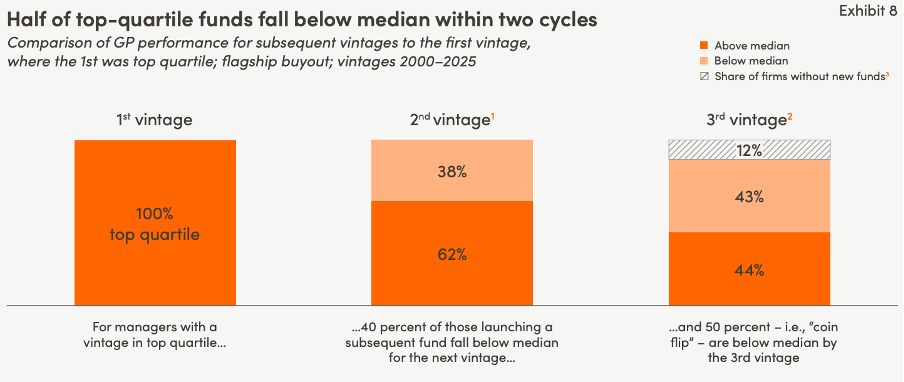
Half of top-quartile funds fall below median within two cycles
👉EQT: The New Rules of Capital
📈 CVC: Building The Case for European Direct Lending
CVC published an update on European direct lending. Below are my highlights:
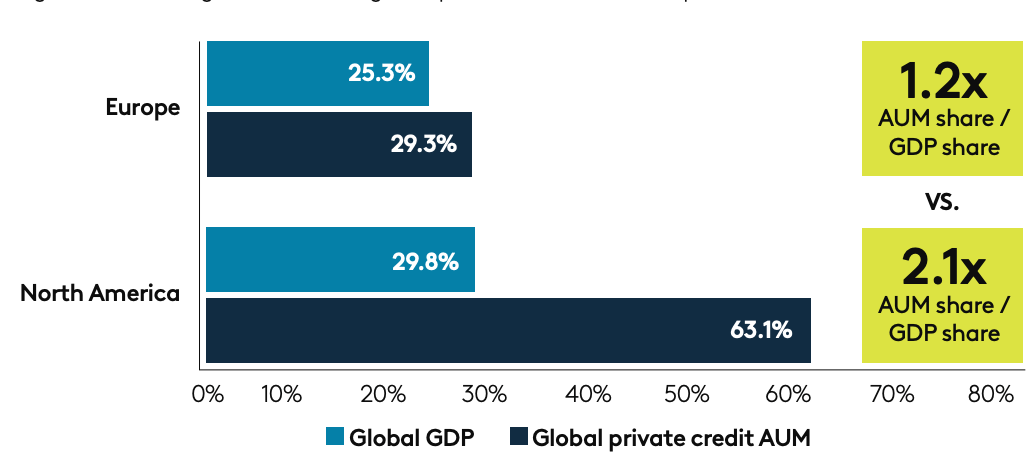
Europe shows significantly lower private credit adoption than North America
Over the past decade, private credit has become a mainstay allocation in institutional portfolios and a primary financing source for mid-market companies.
While that trend is now plain to see, what is perhaps less widely recognised is how much growth potential remains – particularly in Europe, where adoption still trails the U.S. by a wide margin.
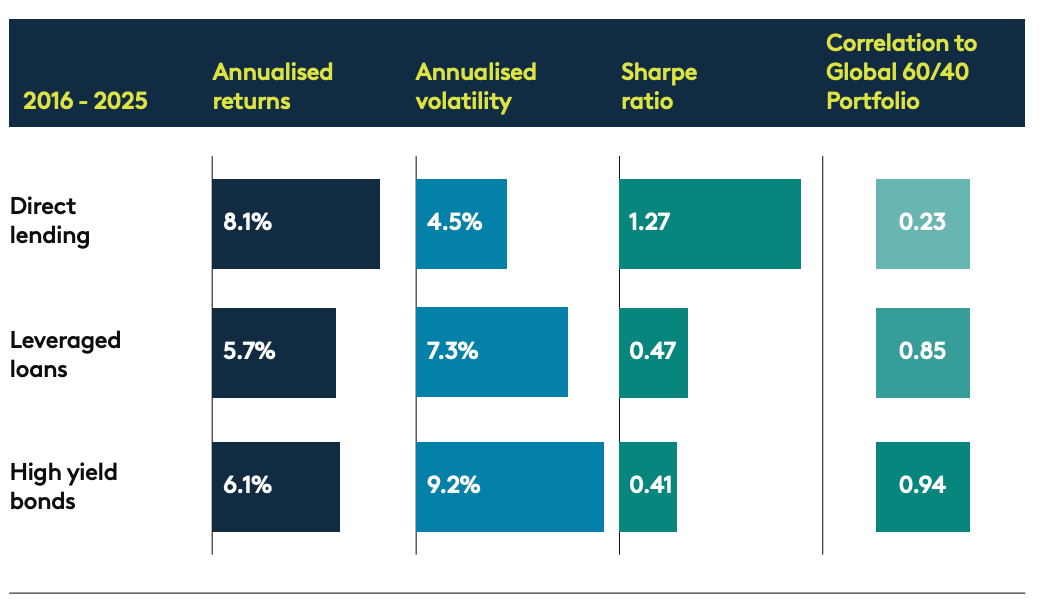
Direct lending has delivered strong risk-adjusted returns
Direct lending’s risk-adjusted returns remain more attractive than those of other areas of leveraged credit, even after adjusting for the smoothing effect of quarterly reporting, which can lead to lower reported volatility in less liquid assets
Its correlation with the traditional 60/40 portfolio is also markedly lower.
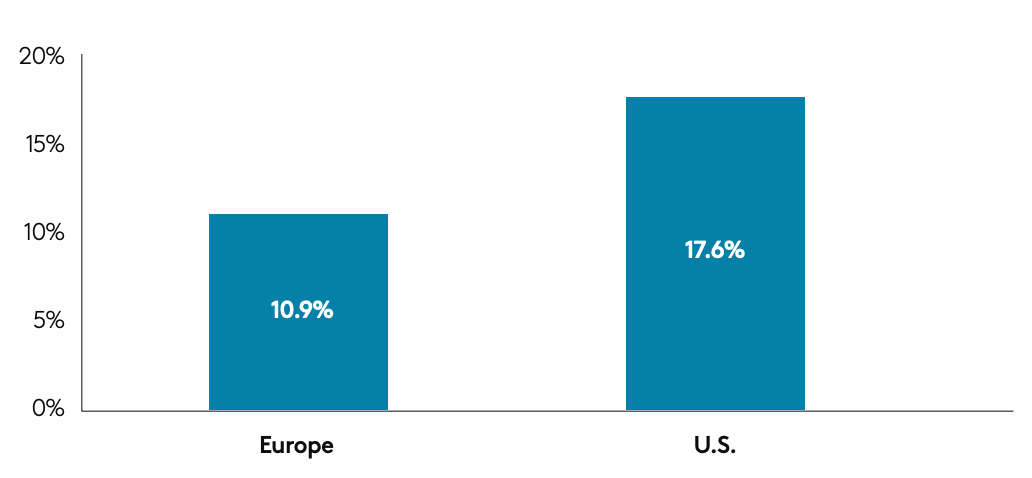
Software as a share of private debt issuance by region
The concentration of software in some private credit portfolios, particularly in the U.S., has become the focal point of bearish media headlines this year. On the headline numbers alone, the U.S. BDC universe seems to warrant some scrutiny
Software as a share of total private debt issuance over the past five years has been noticeably lower in Europe at 10.9% than in the U.S. at 17.6%.
The potential for AI disruption is not uniform across the sector. Vulnerabilities vary considerably by business model, depth of customer integration, and switching costs
For many investors, the question today is not whether to allocate to direct lending, but how best to implement that exposure and with which manager.
💰Fundraising News
Arini’s $4bn Inaugural Direct Lending Fund
Arini, a London-based credit manager, announced the final close of its inaugural Direct Lending Fund I. The fund makes senior secured loans to European founder-led, family-owned, and sponsor-backed businesses. It will target more than $4 billion of deployment.
👉 Arini Announcement
Northwind’s $1bn Debt Fund III
Northwind Group, a New York-based real estate manager, closed its $1 billion Fund III. The fund provides senior bridge loans in major US gateway markets including New York City, South Florida, Los Angeles, and Chicago. It is the largest fund in the firm’s history.
👉 Northwind Announcement
Foundation Credit’s $540m Infrastructure Debt Fund II
Foundation Credit, a US infrastructure debt manager, closed its $540 million Infrastructure Debt Fund II. The fund provides debt to the local US middle-market infrastructure sector across transportation, water and wastewater, sustainable, social and smart infrastructure.
👉 Foundation Credit Announcement
Ascertis Credit $700m Fund IV Second Close
Ascertis Credit, a Singapore-based credit manager, announced a second close of $700 million for its Fund IV. The fund invests in performing private credit in Asia ex-China, focused on India, Singapore and Southeast Asia.
👉Ascertis Credit Announcement
Amundi’s $180m Senior Private Debt V
Amundi, a Paris-based asset manager, announced a first close of $180 million for its Senior Private Debt V. The Article 8 fund makes sustainability-linked senior secured loans to European mid-sized companies with EBITDA of €15-50 million.
👉 Amundi Announcement
This newsletter is for educational and entertainment purposes only. It should not be taken as investment advice.