
👋 Hey, Nick here. A big welcome to the new subscribers from Canyon Partners, T Rowe Price, and Morgan Stanley. You’re now one of the 3,655 subscribers, and you’re reading the 192nd edition of my private credit newsletter.
Reading on Outlook? The charts won’t render. Read it online
📕 Reads of the Week
Market Updates
KKR | Asia starts to bank on private credit
Asian banks provide nearly 90% of the region’s credit capital, compared with 50% in Europe and just 31% in the U.S. But the forces reshaping Japan and driving AI infrastructure investment are testing that model.
Asia already has roughly US$3.8 trillion in private equity, nearly twice Europe’s total, but less than US$90 billion in private credit.
Applying Europe’s debt-to-equity mix would imply roughly US$900 billion of additional private-credit opportunity from sponsor-backed companies alone.
CVC Marathon | Aviation Finance & Leasing
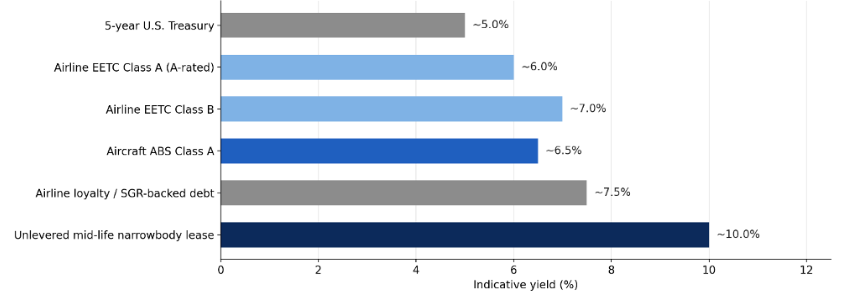
Investors can earn a higher yield from a well-structured operating lease than from aircraft ABS.
Mid-life narrowbodies on operating lease have typically been underwritten to unlevered yields in the high single digits to low double digits.
The higher yield reflects risks that debt investors do not bear, including residual-value, remarketing, maintenance, and lessee-default risk, and the lower liquidity of a whole-asset position.
Also worth reading
Churchill | The core middle market: A structural advantage in private credit 👉 Read the report
Pemberton | Working Capital Solutions 👉 Read the article
Manager Updates
Alt Managers | Credit AUM up 13% to $2.8tn
Continuation and Secondaries Updates
Blue Owl | Credit secondaries fund first close expected in H1 2027
Blue Owl Capital is expecting to announce a first close for its credit secondaries fund in the first half of 2027, according to Secondaries Investor, but it has not yet announced a completed close.
👉 Blue Owl’s Q3 Earnings Transcript
Hamilton Lane | GP-led Secondaries: A Buyout Strategy in Disguise?
The CV market is becoming too big for investors to ignore.
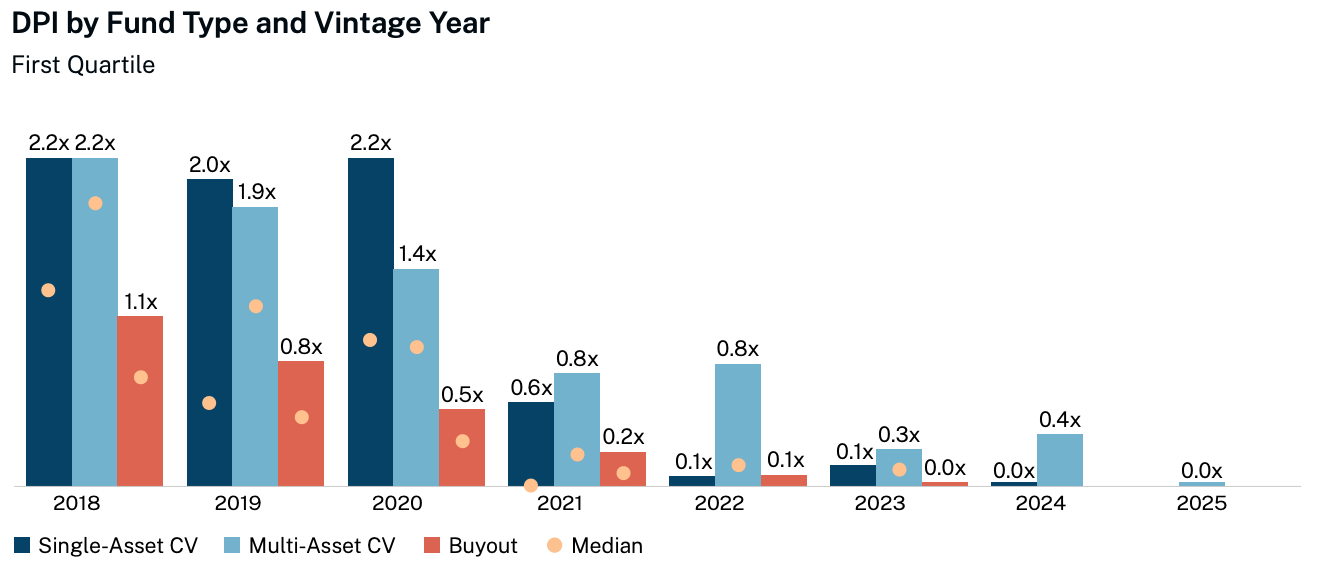
Approximately 10%-14% of all buyout fund distributions in 2025 originated from GP-led transactions. Double the amount in 2021.
Continuation funds’ first-quartile and median DPI are higher than that of buyout funds in most years of the study.
In effect, CVs behave like a buyout allocation on a shorter fuse: high GP alignment, compelling return profile, and a potentially faster payback.
Also worth reading
William Blair | What LPs Think About Continuation Vehicles 👉 Read the report
They say the tallest blade of grass is the first to be cut, and in the lawn of alternative assets, private credit is the tallest blade of grass right now, so it is getting snipped at.
It is arguably a victim of its own success, but the noise will die down, and we can look forward to plenty more positive opportunities going forward.
Michael Ewald, Global head of the private credit group at Bain Capital,
📈 Invesco: Why the Core Middle Market Offers Better Risk-Reward
Invesco published a great piece on investing in the core middle market. Below are my highlights:
Over the last decade, direct lending has experienced extraordinary growth. New capital entered the market, competition intensified, and a growing number of lenders were drawn to the asset class.
Invesco believes the next phase will look very different from the last.
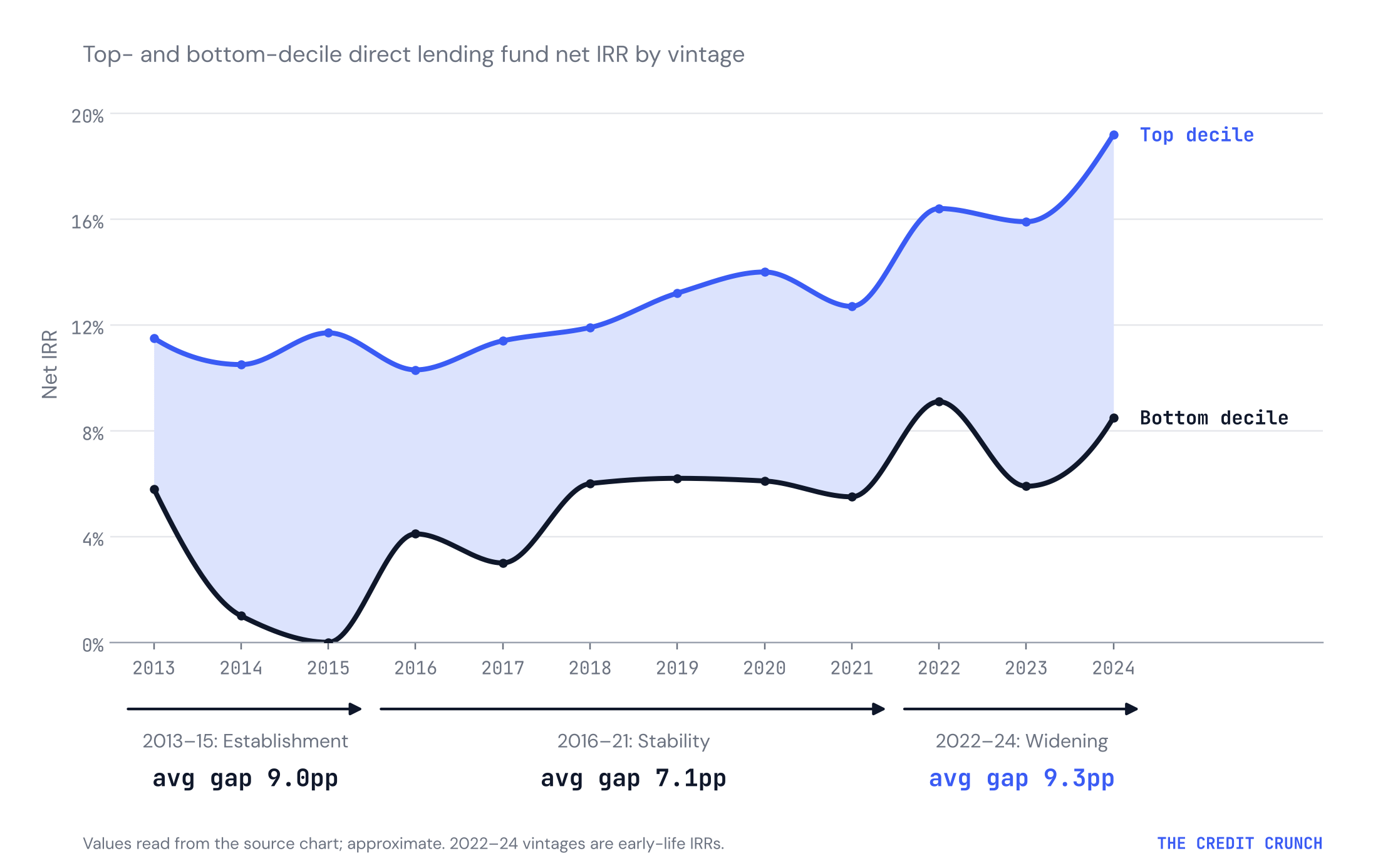
Dispersion is widening
Counterintuitively, the difficult market backdrops often produce the strongest vintages. More selective markets restore lender protections, reprice risk, and widen the gap between strong and weak underwriting.
Dispersion is rising across borrowers, sectors, and managers, and while capital remains plentiful, the cost of deploying it poorly is becoming more visible.
Higher yields can support income, but only where credit losses stay controlled. The spread between vintages shows how much that discipline compounds over time. (See chart below.)
Raising capital and deploying it are different skills
The most underappreciated risk in this market is deployment pressure. The ability to raise assets doesn’t translate into the ability to invest them at attractive risk-adjusted returns, and as platforms grow larger, that pressure builds.
Style drift rarely appears as a single dramatic decision. More often it develops gradually, through slightly higher leverage, a weaker covenant package, a larger position, or a sector outside a manager’s historical expertise. Individually, each decision looks manageable. Collectively, they can change the risk profile of a portfolio.
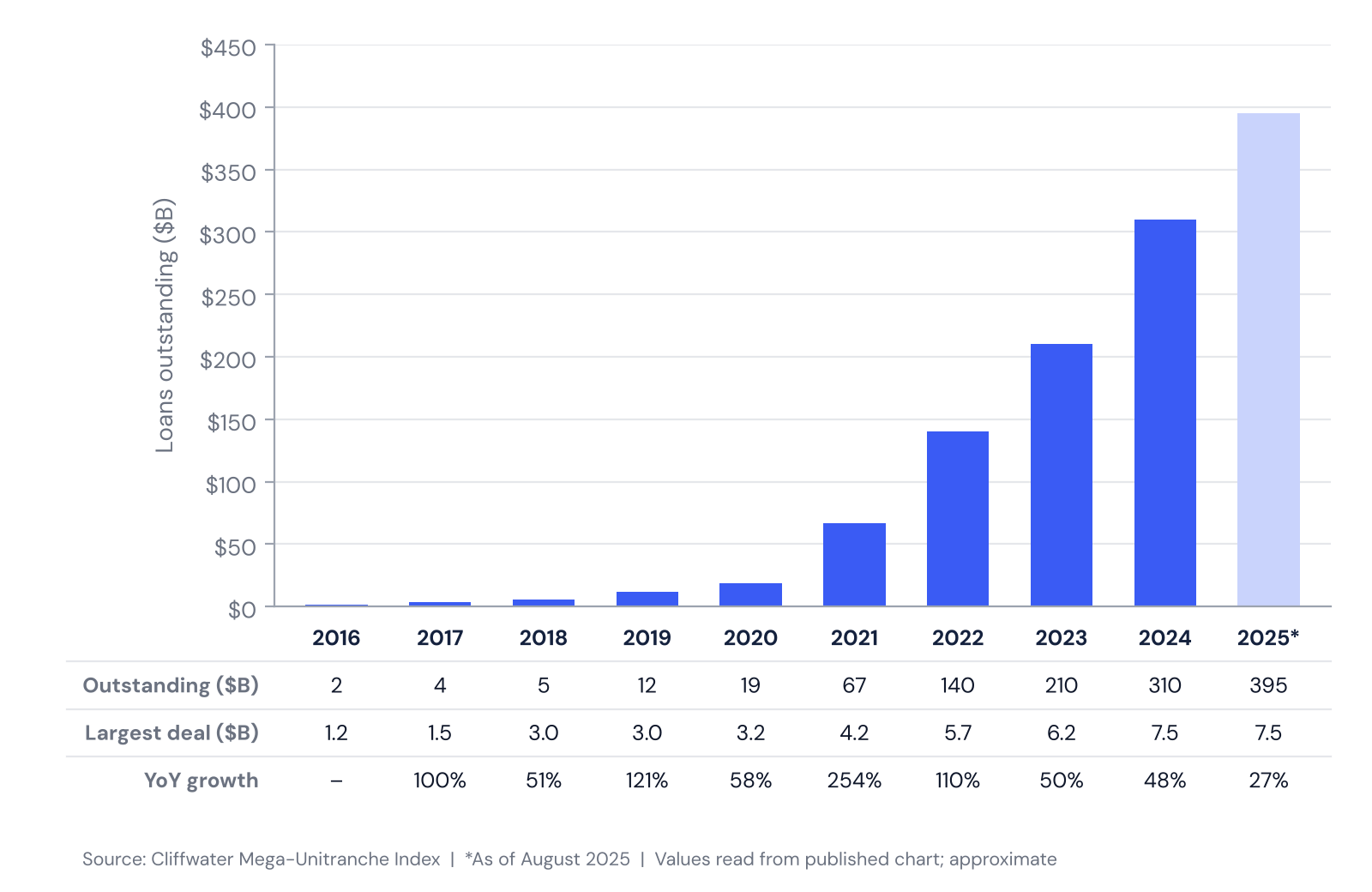
Scale can be an advantage, but it isn’t a substitute for underwriting discipline. Fundraising has concentrated in a handful of large platforms, and the biggest unitranche deals now clear at sizes that were unthinkable a decade ago.
Software was the crowd’s trade; now it’s the test
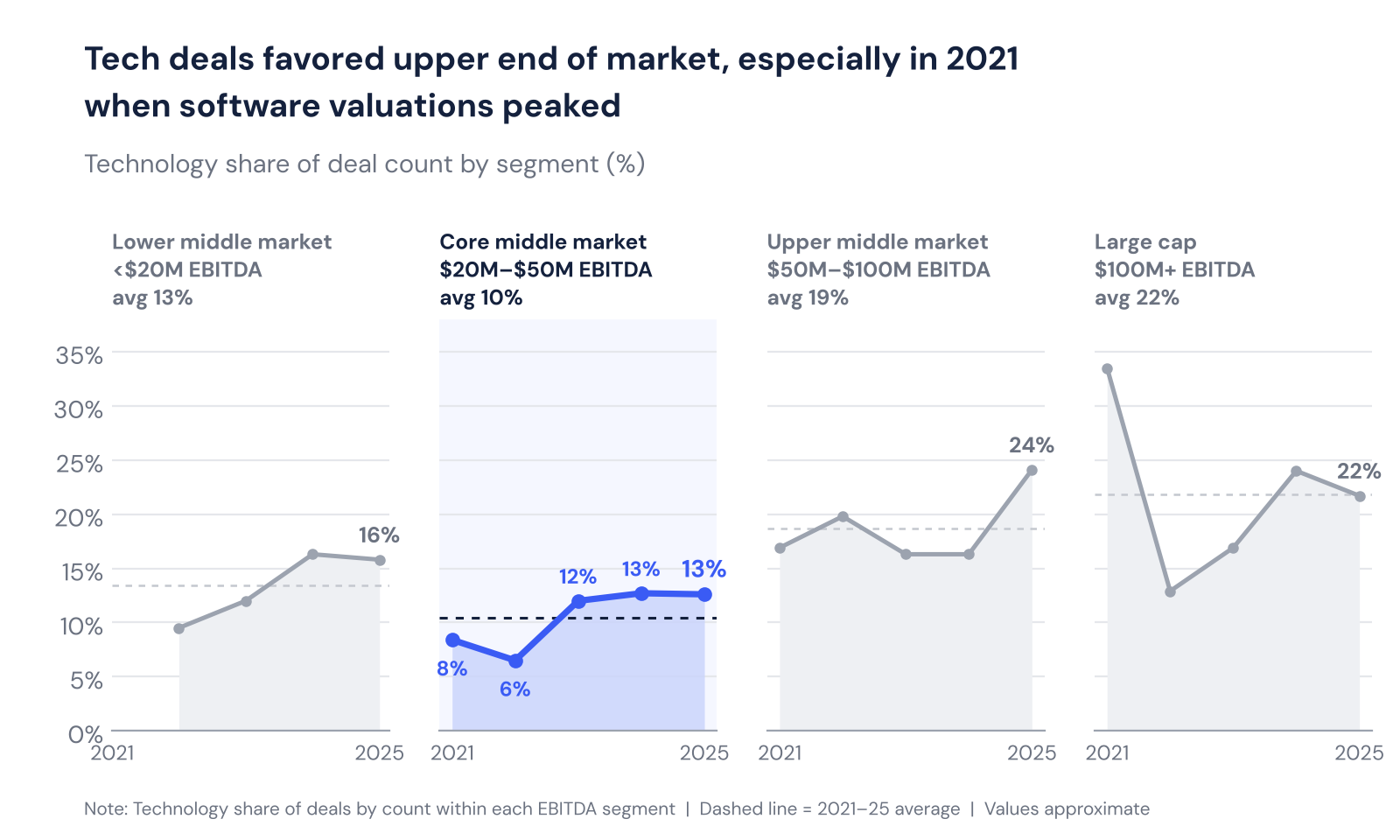
Software has been direct lending’s favorite sector, often 20% or more of new-issue commitments. Recurring revenue, high margins, and strong cash flow made the rationale compelling.
The first quarter of 2026 marks suggest the concentration is beginning to bite.
Information technology carried the highest share of sub-90 PIK loans, more than double the three-year average.
Information technology also took the largest average write-down of any sector.
The lesson on recent volatility within software is that concentration builds when capital deployment becomes the objective.
Invesco favours the core middle market
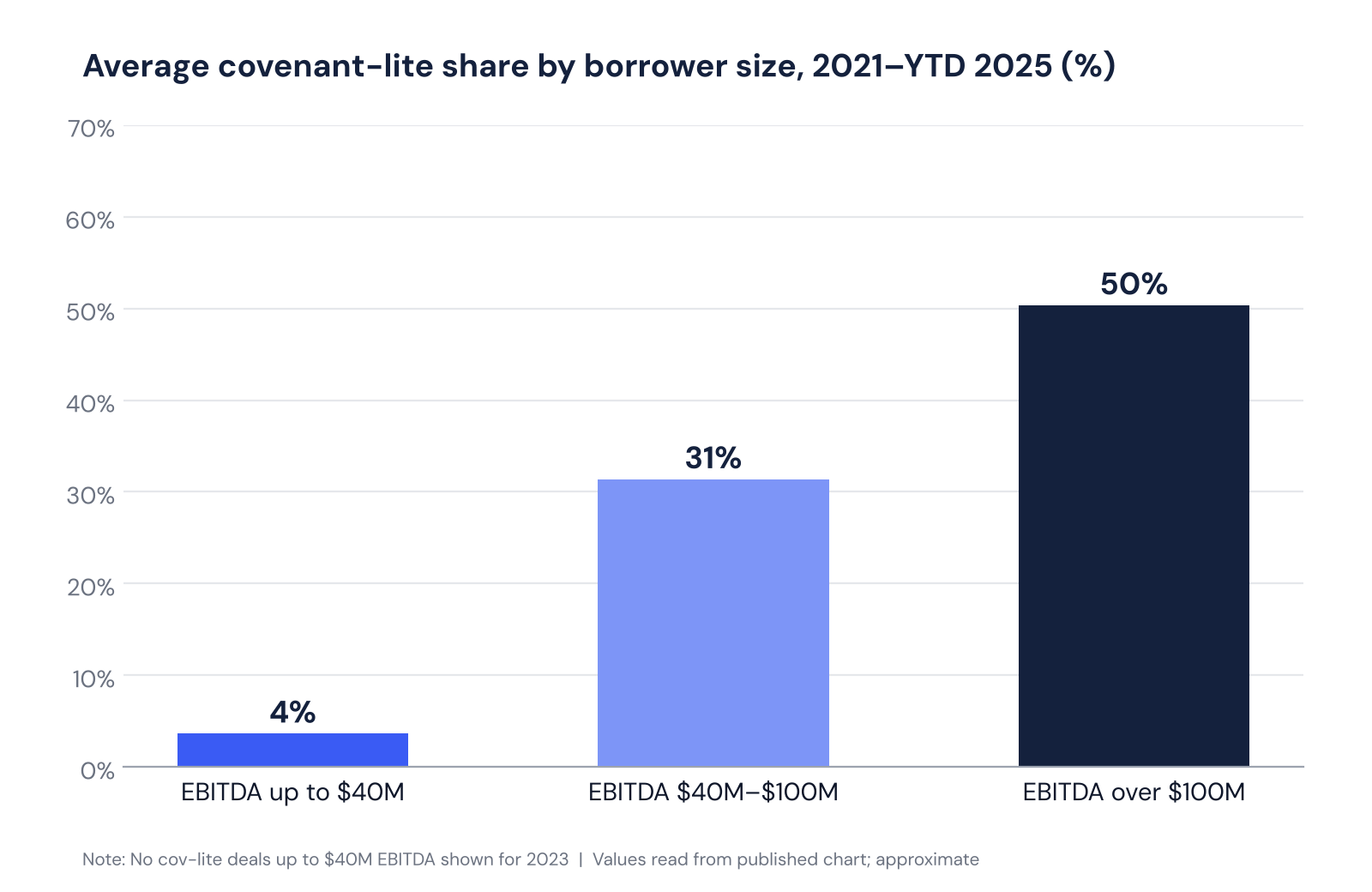
Not all private credit carries the same risk-reward. Invesco believes the core middle market (Companies with EBITDA of $15 million to $75 million) is one of the more attractive places to lend.
These businesses are generally large enough to attract institutional sponsors, and have diversified models and meaningful scale, yet are small enough that lenders can seek to retain influence over structure, documentation, and terms.
This means attractive spreads without stretching for leverage, a greater use of maintenance covenants, stronger lender protections, and smaller lender groups where there is often less competition from the largest platforms.
💰Fundraising News
Direct lending
Blackstone | $14.6bn European Senior Direct Lending Fund IV
Blackstone closed its $14.6 billion European Senior Direct Lending Fund IV. The strategy focuses on both middle- and upper-middle-market companies in Europe.
Apollo | €10bn+ European Credit Company
Apollo launched European Credit Company, a dedicated European performing-credit platform with more than €10 billion of lending capacity. ECC was established to help address unprecedented financing needs in Europe driven by the industrial renaissance. ECC will finance both large and mid-market opportunities, working with companies, sponsors and real asset owners, including infrastructure and real estate.
Proterra | $680m Proterra Credit Fund 3
Proterra Investment Partners, a Minneapolis-based manager, closed its $680 Proterra Credit Fund 3. The fund is exclusively focused on lower-middle-market and middle-market food and beverage companies, including processors, vertically integrated businesses, and branded consumer companies.
Beach Point | $80m first close for BPC Europe SME DAC
Beach Point, an American hedge fund, held a first close of ~$80 million for its BPC Europe SME DAC, its fourth UK and Ireland SME direct lending strategy. The vehicle will provide senior loans of £500,000 to £10 million to growth-oriented UK and Irish companies with turnover below £25 million. The British Business Bank provided a cornerstone commitment.
FSE Group | $94m Future London Growth Fund
The FSE Group, a London-based SME lender, launched the Future London Growth Fund, which is expected to deliver more than $94 million of lending to technology businesses across London. The fund will provide loans of £1-3 million to fill the gap between bank finance and larger venture debt. It will target companies with strong commercial traction that may not yet be profitable but have credible plans to get there. The fund is cornerstoned by the British Business Bank and Funding London, the Mayor of London’s investment arm.
Junior capital & special situations
Churchill | $1.5bn Junior Capital Opportunities Fund III
Churchill Asset Management closed its $1.5 billion Junior Capital Opportunities Fund III. The fund provides junior debt to sponsored US middle-market businesses. The Fund has already deployed approximately $600 million across 44 portfolio companies. Around $665 million of commitments came through rated feeder structures designed for insurance investors.
Neo Alternative | $660m Special Credit Opportunities Fund II
Neo Alternative, an Indian Asset Manager, closed its $660 million Special Credit Opportunities Fund II. The India-focused strategy provides acquisition financing, refinancing, growth capital, and special-situations financing to established businesses. Neo expects to make 35 to 40 investments in the fund.
Infrastructure credit
I Squared Capital | $2.4bn Global Infrastructure Credit Fund II
I Squared Capital, a Miami-based infrastructure investor, closed its $2.4 billion Global Infrastructure Credit Fund II. The fund lends to mid-market businesses that own and operate essential infrastructure, including power generation and grids, fiber networks and data centers, and ports, terminals and logistics. Its loans are secured by physical assets and supported by contracted or regulated cash flows. It provides predominantly senior financing across North America and Europe, drawing on the sourcing networks, sector knowledge and operating experience of I Squared’s equity platform, which has invested in infrastructure since 2012.
Allianz Global Investors | $1.7bn Infrastructure Credit Opportunities Fund II
Allianz Global Investors, a Germany-headquartered investment manager, closed its $1.7 billion Infrastructure Credit Opportunities Fund II. The strategy invests in both senior and subordinated infrastructure debt, primarily in Europe. It will invest across energy, transportation, communications, environmental and social infrastructure.
This newsletter is for educational and entertainment purposes only. It should not be taken as investment advice.