

👋 Hey, Nick here. A big welcome to the new subscribers from Polaris Capital Partners, KBRA, and Santander. You’re now one of the 3,689 subscribers, and you’re reading the 193rd edition of my private credit newsletter.
Reading on Outlook? The charts won’t render. Read it online
It has been a rough year to own an alternative asset manager. The eight largest listed managers are down 16% on average over the last 12 months. Blue Owl is down 30%.
Now step back three years.
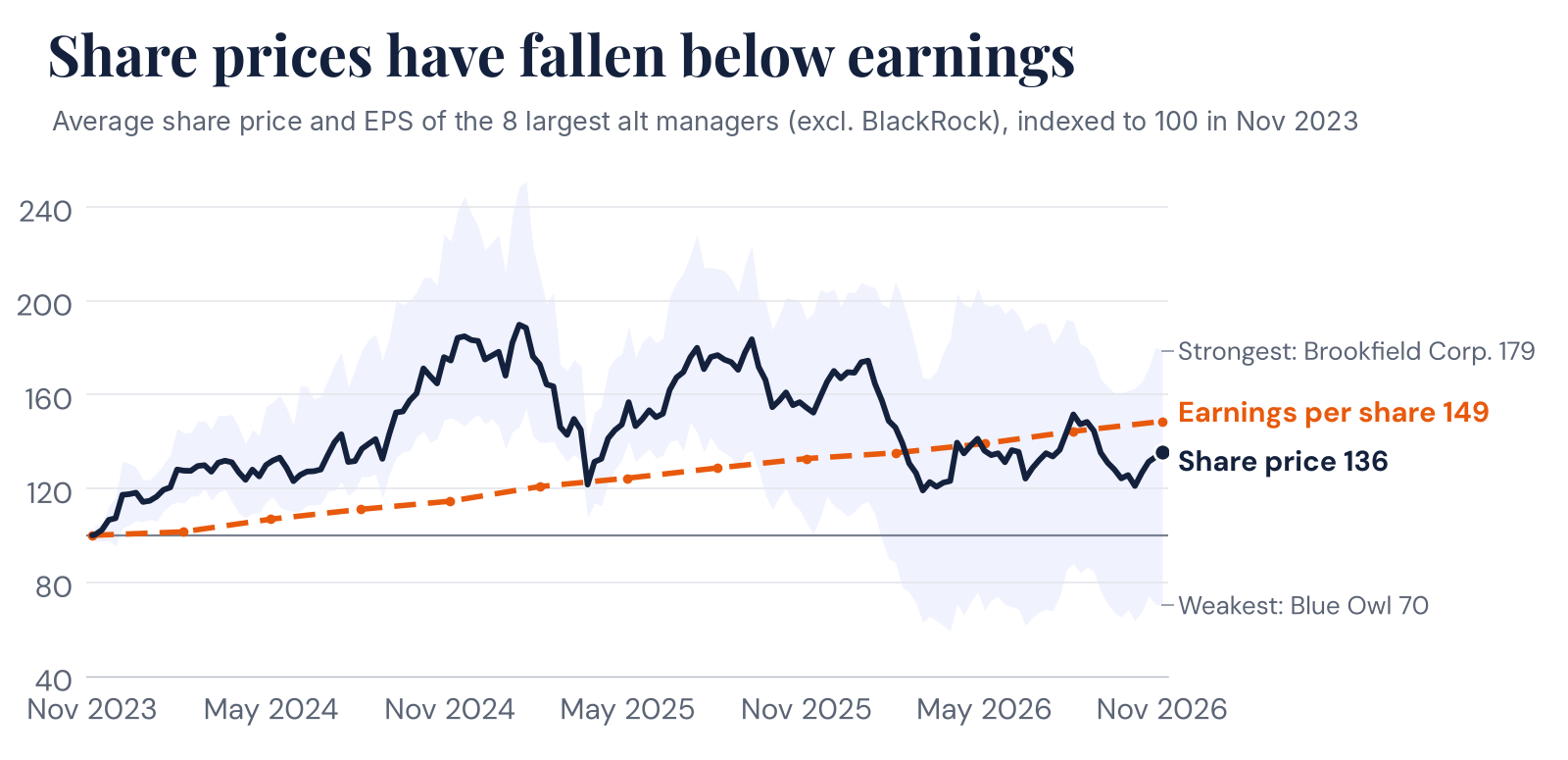
For two years, the share prices ran well ahead of earnings. In 2026, they gave most of that back. Meanwhile, earnings kept compounding, and earnings growth is now ahead of the share price’s.
Behind the volatility, something extraordinary is happening. The industry’s largest managers added $2.1 trillion in assets in just three years.
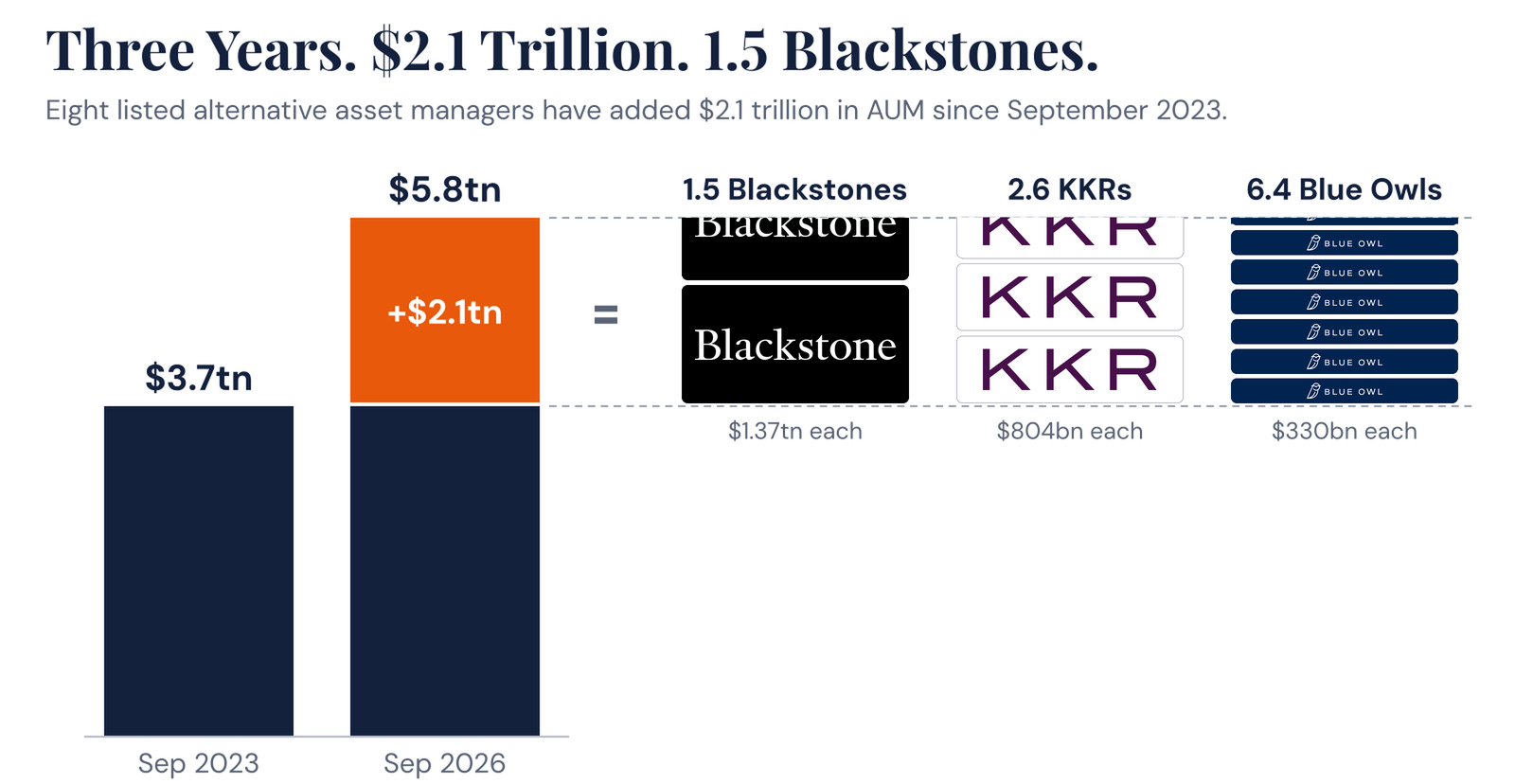
But managing all that additional capital brings a new set of questions.
So what are the industry's largest managers talking about, and how are they approaching those challenges?
Here's my roundup of Q3 earnings calls. If you’re short on time, start with the provocative opinions.
📚 Quotes of the Quarter
Provocative Opinions
65% of the Firms in Our Industry Have Not Experienced a Real Cycle
Our Shares Are Down Meaningfully. Our Earnings Have Grown Nearly 50%.
We Have Returned More Capital in 2026 Than Any Year in Our History
If You Believe PIK Is a Sign of Stress, You Should Believe Stress Is Reduced
Financing AI: Who’s Lending and How
Are the BDC Redemptions Over?
Consensus Views
Provocative Opinions
65% of the Firms in Our Industry Have Not Experienced a Real Cycle
KKR — Scott Nuttall, Co-CEO
Over 65% of the participants in the private markets industry were formed after 2009. They were not even in existence at the time of the global financial crisis. Said another way, only 35% of the market participants have experienced a real recession or cycle. And if you want to go back further to the 2001 recession, less than 20% of the market participants were in business at that time... That is a lot of new players. Most investors are experiential learners. What is happening now, we believe, is that many market participants, a majority are learning by doing. And some of their results will reflect the fact that they have not invested through a cycle before. We expect many of them will learn from it and like us, get better from the experience. Some will disappear. Where we are different is that we have been around for 50 years.
Today’s 5% Treasury Rate Is Below the 50-Year Average
KKR — Scott Nuttall, Co-CEO
Speaking of history and to put a finer point on it, the average 10-year Treasury yield since KKR was founded in 1976 is 5.8%. The average Treasury yield since the beginning of 2010 is 2.7%. Said simply, today’s Treasury rate at around 5% is less than the 50-year average since KKR was founded. But the market has only known our space in a public context in a 2% to 3% or lower interest rate environment until very recently... But the public market has not had the benefit of experiencing that yet and uncertainty and fear tend to be very powerful emotions.
Our Shares Are Down Meaningfully. Our Earnings Have Grown Nearly 50%.
Blackstone — Steve Schwarzman, Chairman and CEO
Despite the firm’s extraordinary record of growth over four decades, and our unique positioning in the alternatives sector, Blackstone’s stock – along with the other alternative managers – has been under pressure... Over the past two years, while our shares are down meaningfully, our earnings have grown nearly 50% – with commensurate growth in our dividend. In my experience, disconnects of this type don’t typically last.
FOMO Is Not an Investment Strategy
Apollo — Marc Rowan, CEO
So much of what we’ve seen in the press and what we’ve seen from our competitors is about the bubble. FOMO is not an investment strategy... In the equity business, you are paid to be concentrated, because you have unlimited upside. In the credit business, you only get interest in principal. And, therefore, if a company wants you to hold concentrated amounts of their credit, they need to offer you two things: more return and more safety.
We Have Returned More Capital in 2026 Than Any Year in Our History
KKR — Rob Lewin, CFO
We have already returned more capital to our clients in 2026 relative to any year in our history, and that is excluding Q4 activity and the announced USI transaction. This stands in sharp contrast to the muted monetization activity that we are seeing across our industry, and I think reflects both the performance of our portfolio and the benefits of our disciplined approach to linear deployment and portfolio construction... We expect that figure to reach over $40 billion in 2026, exceeding our previous annual record by more than 50%.
99% of Investment-Grade Bonds Do Not Trade Most Days
Apollo — Marc Rowan, CEO
On moving Apollo’s entire credit business to estimated daily valuation.
You saw us on June 30 go to estimated daily value for the entirety of our investment-grade suite of products. On September 30, we went to estimated daily value for the entirety of our credit business. Those who said this could not be done just simply don't understand. To give you a sense of what the public market is, 99% of investment-grade bonds do not trade most days... Therefore, 90% of the US investment-grade market effectively marks the model off a curve, off liquidity, off beta on a daily basis. We have that same opportunity, provided we make the investment in data and systems necessary to support this, and we intend to continue to drive this forward across our business rather than retreat.
If You Believe PIK Is a Sign of Stress, You Should Believe Stress Is Reduced
Blue Owl Capital Corp — Craig Packer, CEO
We've gone to great pains in these calls to highlight that we are structuring our PIK intentionally, and we don't see it by itself as an indicator of stress. We also know some investors are skeptical about that. I would highlight for those that are skeptical, it's gone down two quarters in a row. So, if you believe that it's a sign of stress, then you should believe that stress is reduced.
Financing AI: Who's Lending and How
AI capex dominated the calls. The managers agree on the size of the need; they split on whether to lend against the chips or only the buildings and power around them.
How big is it?
BlackRock — Larry Fink, Chairman and CEO
If you think about it, a 1 GW data center in the U.S. is about a $50 billion enterprise cost. 40% of that is the cost of GPUs and chips. The other 60% is power, grid, core and shell.
Ares — Michael Arougheti, CEO
Asked why Ares has been absent from the large IG chip financings.
In its most simplistic form, the way I think about it is the identified CapEx need as of today is a little over $5 trillion between now and 2030. If you break that down further, about $2 trillion of that is for the physical data center buildings and the adjacent power gen infrastructure and transmission. There is about $3 trillion of financing for GPUs and chips... Without casting aspersions on GPU financing, I would maybe say that we are finding plenty of really attractive risk-return opportunities in debt and equity in that first $2 trillion bucket.
Who makes money?
Brookfield — Bruce Flatt, CEO
On AI.
As with every major technological transformation, there are immense opportunities but also risks. We have seen this before with railways, automobiles, electricity, telephones and the Internet. What is different this time is the speed and scale, which are far greater than in previous cycles. What is less clear is who ultimately will make money and how they will make it.
Apollo — Jim Zelter, President
So, what do we know? We know that society will use dramatically more computing power in the future, the demand for energy will rise with it, the demand for chips will remain strong, and then AI capabilities are improving in an extraordinary rate. What we don't know is how pricing and economics will evolve or which parts of the ecosystem will earn an attractive return on the capital being committed... And for these reasons, our origination investment activity has been predominantly focused on the capital imbalances we see in two sectors, power and chips, two areas where we see attractive risk-reward and that we have high conviction. Our goal applied to AI-related assets or otherwise is simple: beat a basket of IG public debt with better structure, better security, and better spread.
Lend against the chips, or only the buildings?
Apollo — Jim Zelter, President
And in compute, we led a $40 billion GPU financing for SpaceX... We built this platform to provide capital at scale, and we believe few, if any, in our industry can do what we do.
Ares — Michael Arougheti, CEO
On GPU financings, and why Ares has stayed out of them.
I think our colleagues in ABF did a really nice job articulating some of the concerns around GPU financings. They tend to be a little bit more complex. They tend to be a little bit more concentrated and, at least I, for one personally, do not know how to underwrite the decline in depreciation curves on that type of technology. At least for the time being, we're kind of sticking to the half of the market that we understand best and where our capability set is the deepest.
Blue Owl — Marc Lipschultz, Co-CEO
Asked about financing chips and GPUs.
A chip financing is very, very different from a data center financing. Data centers are extremely long-lived assets the way we're doing them, right? ... I mean, anecdotally, we still own a data center that was originally an AOL data center, and it's still occupied, leased and paying rent... Chips have a lot of technology risk. Chips, therefore, have a very much -- by definition, have a much shorter lifespan, and they require a very different kind of structuring, different duration. So one ought not conflate the two.
Blackstone — Jon Gray, President and COO
One thing that I think will evolve over time is an understanding that the compute itself has value. When you look at the airline business, you know, lending against aircraft is an investment-grade business, not because Spirit Airlines or an emerging market airline has great credit themselves, but it's because of the shortage of commercial aviation in the world. Today, when it comes to compute, be it data centers or chips, people are not putting much value on the underlying assets. They're solely looking at the credit of the counterparties. I think that will evolve over time, which will expand some of the capacity these insurance companies have.
Are the BDC Redemptions Over?
Ares — Michael Arougheti, CEO
On redemptions at Ares' non-traded BDC, ASIF.
80% of the capital has been returned to investors who submitted a tender in Q1. If you look at net new redemptions, we are down 60% quarter-over-quarter... As we have said before, that redemption queue has largely been concentrated in international wealth with small institutional and family office investors, and so it is very easy for us to see those organizations and see them burning down quarter-over-quarter... So it is kind of getting this pig through the python of this concentrated international wealth queue, and we are really advanced in that.
Ares — Michael Arougheti, CEO
I do not want to say that the BDC redemption story is a canard, but it is kind of getting... a little bit too much air time relative to the appetite that we are seeing broadly in wealth and broadly for private credit.
Blackstone — Jon Gray, President and COO
In credit, where there was all this talk of some sort of private credit apocalypse earlier this year – of course, none of that has come to pass. We're delivering for the customers and that's the key thing. And this market, as you know, is very underpenetrated. Investors globally are probably about 1% allocated to private assets.
Consensus Views
1. Higher for Longer: Rates and Macro
Ares — Michael Arougheti, CEO
If you look at our credit business, 83% of our assets in the credit group are floating rate. As base rates go up, that return flows through not just to the investor in increased IRR, but it flows through to us in increased profit. What is interesting about where we are now, these credit portfolios have already been through a rate environment that was 100 basis points higher than where we are today. If you look at interest coverage levels at the trough, they were kind of 1.6-1.7, and now they are sitting at 2.1-2.3 or 2.4. We know that these companies can handle a higher debt service load because they have already managed through it.
BlackRock — Larry Fink, Chairman and CEO
For the first time in my career, and that's 50 years of a career, I'm seeing genuine shortages of capital. Governments are running historically large deficits, while at the same time, demand for private capital is rising across the economy. Governments need financing for infrastructure. Companies need to fund a generational AI build-out. Individuals need better ways to invest and retire.
2. Market Risks, Bubble Debate & Big Narrative
A year after the private credit scare began, the managers are taking risk down, not up.
Apollo — Marc Rowan, CEO
The world can be very confusing or the world can be very simple. We look out and we see valuations in almost all markets relatively high. We see risk relatively elevated. The logical conclusion from high valuations and increased risk is to take risk down. In our credit business, taking risk down means moving from below investment-grade to investment-grade and moving from unsecured to secured.
Blackstone — Jon Gray, President and COO
We're aware of the risk whenever you have this kind of large investment boom, which is why we focus so much on the picks and shovels, why we focus so much on long-term contracted assets, why we focus on not doing things on a speculative basis... The shortage of compute is growing and that's making what we build, the entitled sites we have that are powered, they're actually more valuable today... There seem to be fewer players who can do this, and that puts us and our investors, we think, in a very good spot.
Blue Owl Capital Corp — Craig Packer, CEO
A year ago, sentiment toward private credit shifted meaningfully as investors became increasingly concerned that credit issues would begin to emerge across the asset class. That change in sentiment created significant volatility for BDC stock prices, including OBDC. One year later, we believe OBDC's performance has demonstrated the quality and durability of the portfolio. Our borrowers continue to perform well with healthy earnings growth, while credit quality remains strong with non-accruals at just 0.8% of the portfolio at fair value.
Apollo — Jim Zelter, President
While the opportunity is massive and compelling, we will remain disciplined. After 40 years in the business, my rule is simple: never take equity-like risk for debt-like returns.
3. Fundraising & Capital Formation
Institutions are writing bigger cheques to fewer managers, and credit is still taking a large share of new money.
Blue Owl — Marc Lipschultz, Co-CEO
And what is becoming more obvious over time is that our business is far more diversified than many had perceived it to be, with growth coming from an increasingly broad set of strategies, investors and geographies. Institutional and insurance investors have driven about 70% of our last 12-month equity capital raised, and these investors committed approximately 20% more to our funds than this time last year and over 150% more than the same period 2 years ago. Notably, credit was nearly 45% of our equity capital raised over the last 12 months and 55% in the third quarter, reflecting continued investor engagement contrary to popular narratives.
TPG — Jon Winkelried, CEO
Across our most recent cycle of fundraises, we've grown fund sizes by 30% on average and have welcomed more than 200 new clients to our firm since the beginning of 2025. Against the difficult fundraising backdrop, we continue to take share as many of the world's largest and most sophisticated investors are increasingly partnering with TPG and given our distinct strategies and consistently differentiated performance.
4. Deployment & Origination
Sponsor M&A is still slow, so deployment is moving away from US direct lending.
Ares — Michael Arougheti, CEO
Asked whether higher rates will reset U.S. direct lending deployment.
I don't read across high rates to mean slower deployment... There is about 32,000 companies that are currently owned by private equity firms. It is about $3.5 [trillion]-plus of capital on the ground, and you have got $1.5 [trillion]-plus of dry powder that is also aging out, so the kind of weight of capital is ultimately going to be the driver of deployment... Not surprisingly, when the M&A environment is slowing for PE, we start to see it pick up in places like opportunistic credit, secondaries, credit secondaries, GP solutions, and the like. When you look at the diversification of the deployment, I just don't think that you're going to see the historical dependence on U.S. direct lending that we've seen in years past.
Carlyle — Harvey Schwartz, CEO
Hard to unbundle precise deployment because we put no pressure on the teams to deploy. What we really demand from the teams is that they price the risk correctly, and we are seeing some pretty attractive opportunities out there. I think as we come into 2027, we are going to continue to see great opportunities to price marginal risk, but that is how the teams are thinking about deployment.
5. Returns & Performance
The managers able to hand cash back are making it their main selling point.
KKR — Scott Nuttall, Co-CEO
First thing you need to do when you have a disruptive technology in our experience is get out of the way of disruption. We did an inventory of what we owned 4 or 5 years ago and looked at everything through the lens of where is AI an opportunity, a threat, or a question mark. If it was a threat or a question mark, we decided to try to get out of the way. And so we sold some businesses that we are worried about... We learned that from what happened with the Internet event.
KKR — Scott Nuttall, Co-CEO
On selling AI beneficiaries.
Second, we recognize we own some assets today that are really benefiting in an outsized way from what's going on with AI. We've been selling those in some cases. This year, Kokusai is a good example in Japan, semiconductor equipment business... We sold Kokusai for roughly 20x our investors' cost, CoolIT for 15x. Maybe if we'd held them longer, we could have done better than that, but those are pretty good outcomes.
Carlyle — Harvey Schwartz, CEO
In a sector where clients are feeling that they're not getting adequate return on capital, if you're one of the outliers that's actually returning capital, obviously, that resonates with them... We had very little exposure to software or areas where very high multiple positions were struggling to come through the marketplace. I think it's still going to take the industry a bit of time to digest the capital that is a bit trapped.
6. Portfolio Quality, Defaults & Non-Accruals
Borrowers are still growing earnings.
Blackstone — Jon Gray, President and COO
We saw in our BCRED portfolio double-digit EBITDA growth for our borrowers. Debt service coverage ratios are 2.3x. There is a tale of some of the legacy older deals, but that's a small minority. Overall, we're seeing pretty good credit health out there.
Ares Capital — Jim Miller, President
Specifically within our software portfolio, we continue to see strong operating performance across our investments with organic LTM EBITDA growth in line with the broader portfolio average during the third quarter. Within our software portfolio, only 1 small loan is currently on nonaccrual, and our debt investment remains supported by loan-to-value ratios in the low 40% range, providing substantial equity value beneath our positions.
7. Spreads, Pricing & Market Conditions
Ares — Michael Arougheti, CEO
We saw spreads gap out 50 to 75 basis points earlier in the year... But spreads typically react to changes in credit performance, not changes in base rate. And so until we see meaningful uptick in defaults and losses, I do not think that base rates in and of themselves are going to impact the spread environment.
Apollo — Jim Zelter, President
If you look at the last 6 to 12 months, the hyperscalers have had to come into the marketplace, spreads have continued to widen out. But we would argue, when you even look where Meta is issuing today as a public IG paper, as a AA, spreads are very robust. And in an era where real yields are positive and real for the first time in 18 years, by being able to achieve 8% to 9% on these type of financings, we think in a world where more and more folks are savers, more and more funds are looking to put more fixed income to work, it's going to be much broader.
8. Investment Grade Private Credit & Insurance Demand
Blackstone — Jon Gray, President and COO
We've established the largest non-captive insurance platform in our industry, including 40 clients in our dedicated insurance solutions area – representing leading global firms, of which over half expanded their relationship with us in the past twelve months. Our investment grade private credit platform specifically grew 24% year over year to nearly $150 billion.
9. Real Estate, Infrastructure & Data Centers
Blackstone — Jon Gray, President and COO
On why real estate is better placed than in the 2022 rate-hiking cycle.
Today, there are three positive dynamics that didn't exist in 2022. First, demand is accelerating in key sectors, including data centers, where we expect a three-fold increase in leasing this year across our global platform; and logistics, where our U.S. holdings saw record leasing activity in Q3... Second, new supply has fallen to decade-plus lows across most types of real estate while the cost to build continues to increase – a development further accelerated by higher rates and crowding out from the AI infrastructure build. And third, real estate debt markets have remained resilient, unlike in 2022, with the availability of debt up sharply this year.
TPG — Jon Winkelried, CEO
On real estate.
Current environment is impacting real estate investing through elevated financing costs, valuation uncertainty and reduced liquidity. This is placing additional stress on owners legacy assets acquired at peak valuations and lower rates, driving further capitulation and the need for solutions capital... At the same time, traditional real estate lenders with legacy exposure have become more cautious and selective. This has created a constructive backdrop for well-capitalized real estate credit investors, such as TRECO.
10. Manager Strategy & Platform Growth
Apollo wants to change how private markets are sold and traded.
Apollo — Marc Rowan, CEO
Almost the entirety of our industry was driven by one client, one client being the alternative bucket of our institutional client base. We, now as an industry, have six clients. We've added individuals. We've added insurance companies. We've added the debt and equity bucket. We've added traditional asset managers and 401(k) and DC... The problem or the opportunity is those five new buyers do not want what the first buyer wanted. Many in our industry believed that these five new buyers would come to them in the existing structures and the existing products.
11. Wealth, Retail & 401(k)s
Apollo — Marc Rowan, CEO
It will not surprise me if we see in the future guaranteed 2 or 3 times, MOIC guaranteed outcomes 17 or 18 years from now to pay for college. The more we become a solution rather than a policy or a product, the better chance we have. Now, the reality is our industry is growing, just as a result of population going, and it will grow through 2050. However, our share of the retirement market as an industry is going down. We have an opportunity to just ride the industry trend as so much of the population, not just in the US but everywhere in the world ages, and the world is short guaranteed income.
Brookfield — Nick Goodman, President
Asked whether the midterm elections change the outlook for alternatives in 401(k) plans.
Enabling individuals to access private markets through their retirement savings is a good thing, [it] provides diversification. It enhances risk-adjusted returns. And so as a result, we do expect that the channel will continue to open up with the appropriate risk and safeguards.
12. Partnerships & Strategic Alliances
Blue Owl — Alan Kirshenbaum, CFO
On why institutional fundraising hit a record.
So first, we continue to see an increasing desire for institutions to identify a handful of managers to build large-scale partnerships. More and more of these institutions recognize that larger partnerships offer better economies of scale, obviously. They offer the ability to access key opportunities across private asset classes with one firm. And to navigate different investment environments collaboratively and successfully as partners rather than just passive investors in funds.