
👋 Hey, Nick here. A big welcome to the new subscribers at MacKay Shields, PGIM, and KKR. You’re now one of the 3,510 subscribers, and you’re reading the 187th edition of my private credit newsletter.
Reading on Outlook? The charts won’t render. Read it online.
Our industry is increasingly K-shaped, and most of the external focus is going to be on the unhappy part of the ‘K’.
We find ourselves on the happy part of the ‘K’, and that’s what’s showing up in the numbers.
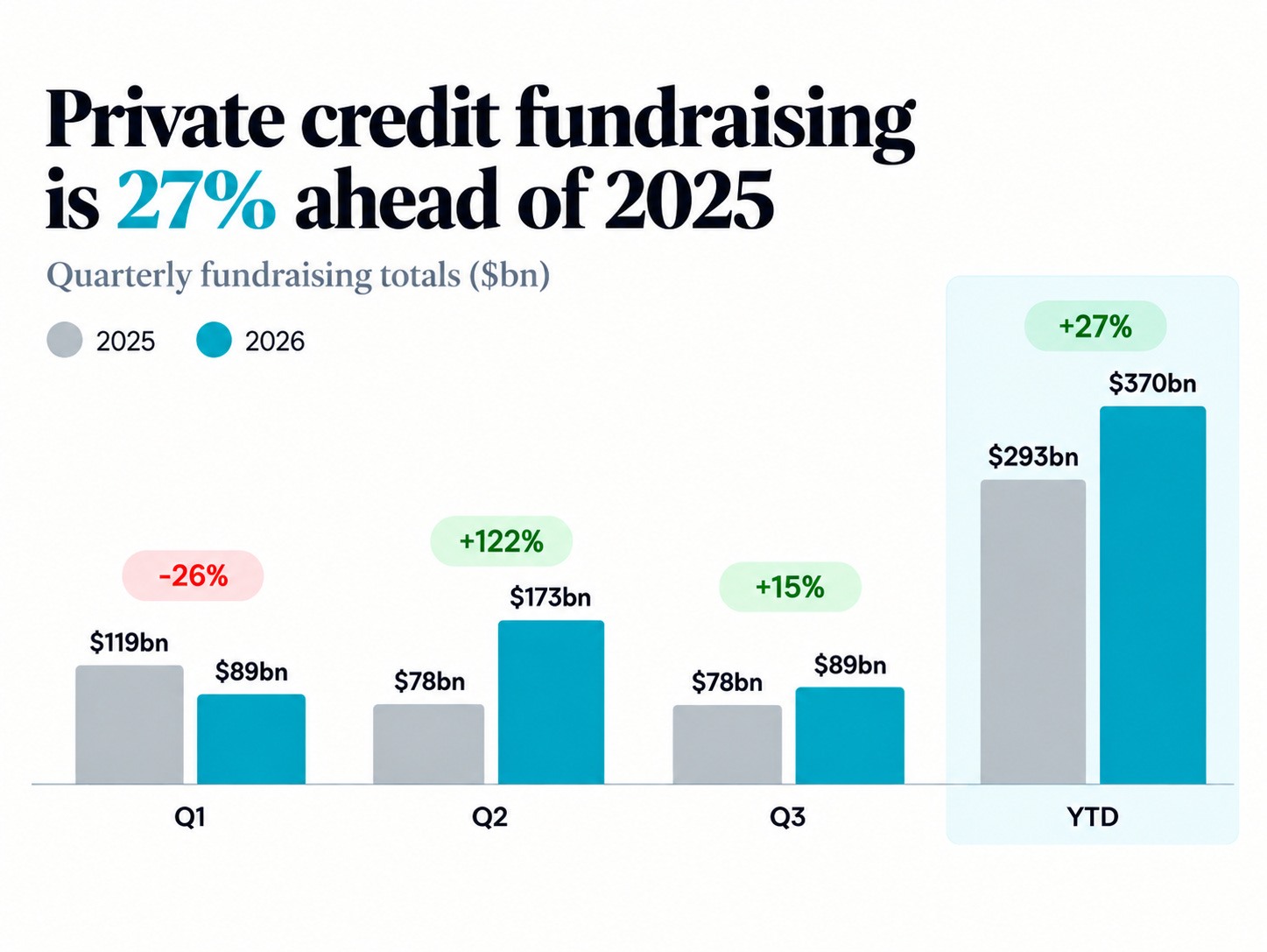
For all the noise around private credit, fundraising continues to tell a much more resilient story. Year-to-date fundraising is up 27% compared to last year. This increase alone is four times as large as the total BDC redemption requests everyone’s been banging on about.
But it’s not all up and to the right. LPs are becoming much more selective, concentrating capital into fewer funds. New, niche, and subscale strategies have been hit hardest.
Private credit is now entering a new normal defined by greater bifurcation and wider dispersion of returns.
In a more differentiated market, selectivity becomes the primary driver of returns.
North America Pulls Away
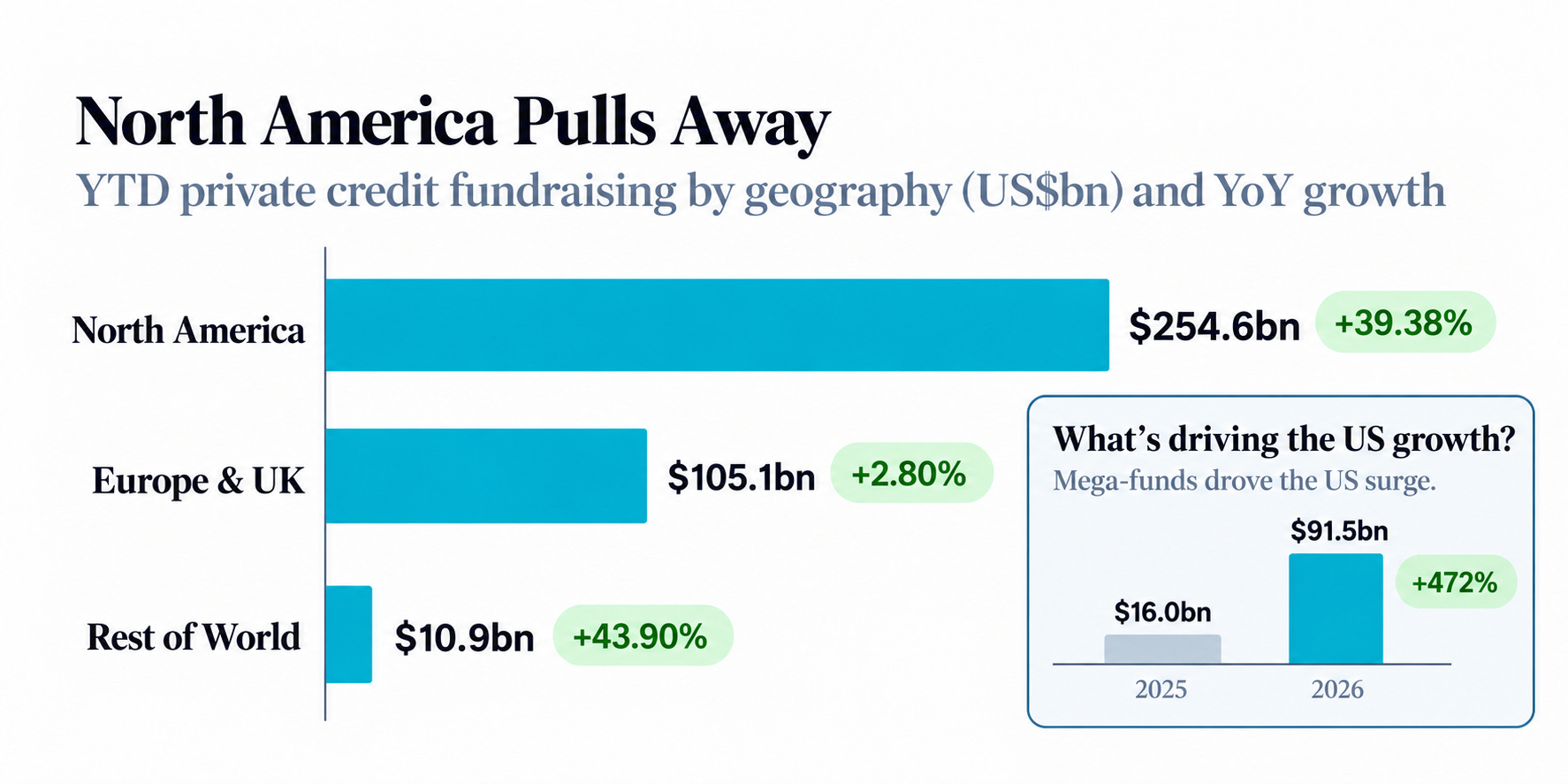
US private credit fundraising grew 40% year on year, with the increase almost entirely driven by the largest funds. Funds larger than $10bn raised six times as much capital compared to the same period last year.
Unlike the US, Europe’s growth has been muted. The number of funds raising fell around 25% year on year, leaving larger average fund sizes to drive the increase. Year to date, nearly twice as many US-based funds have raised capital as European funds.
Asia’s private credit fundraising momentum continued in Q3. Ares and Partners Group both announced notable funds in the quarter.
The Five Largest Funds in Q3 Raised 50% of the Capital…
We’re a winner, but not everybody has had the same experience
It is a tough fundraising environment. We’re fortunate that if you look at our institutional business, we’re basically — have almost double last year’s production through six months... That’s not every GP...
We’re a winner, but we recognize that not everybody has had that same experience.
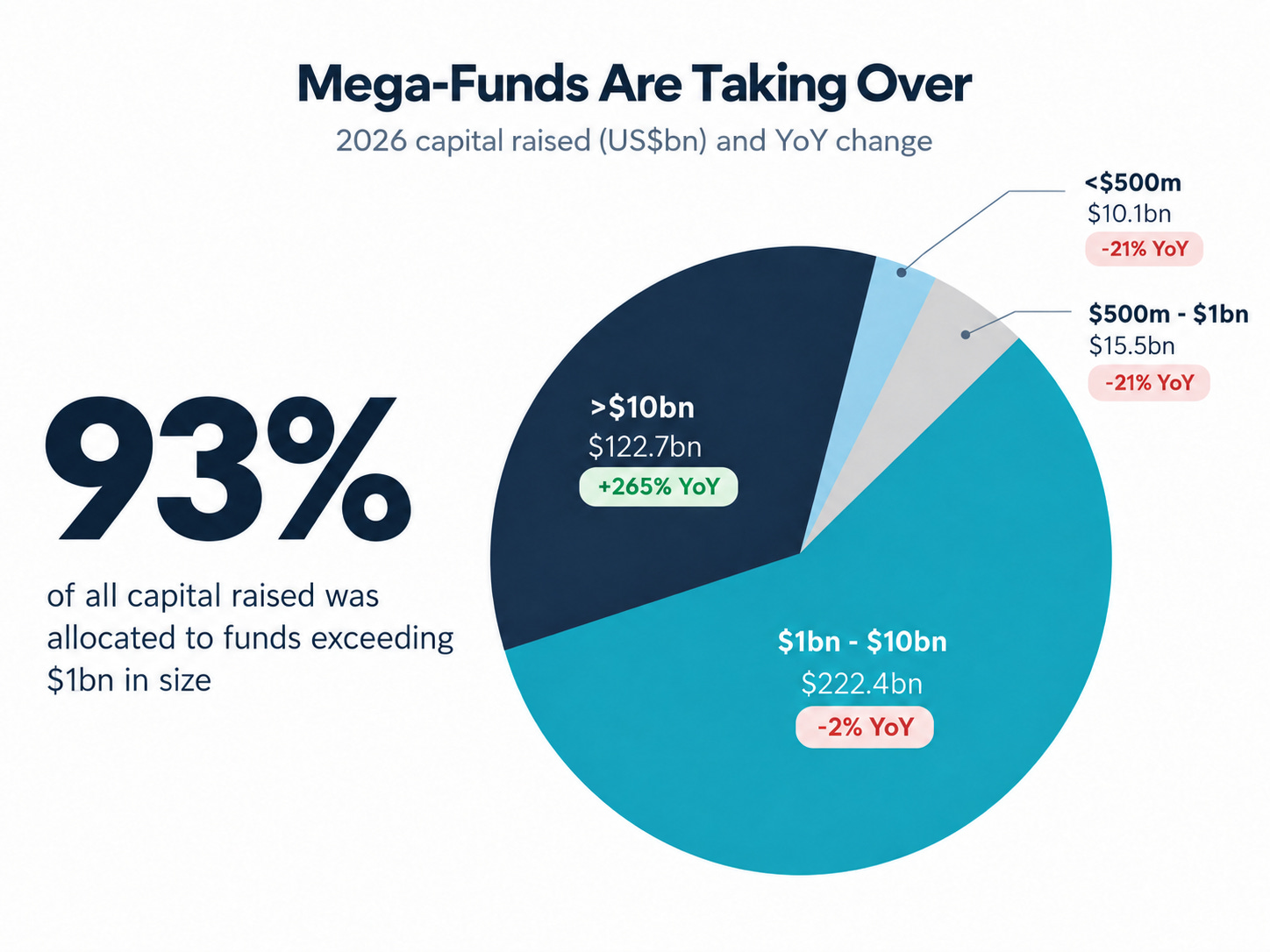
Funds larger than $10bn are the only segment of the market growing this year. Every other fund-size category has declined in both the number of funds raised and total capital raised.
Sub-$500m funds have been hit particularly hard, where fewer managers are raising capital, albeit in slightly larger vehicles.
📕Nick’s Top Articles for Q3
Secondaries are the fastest-growing strategy
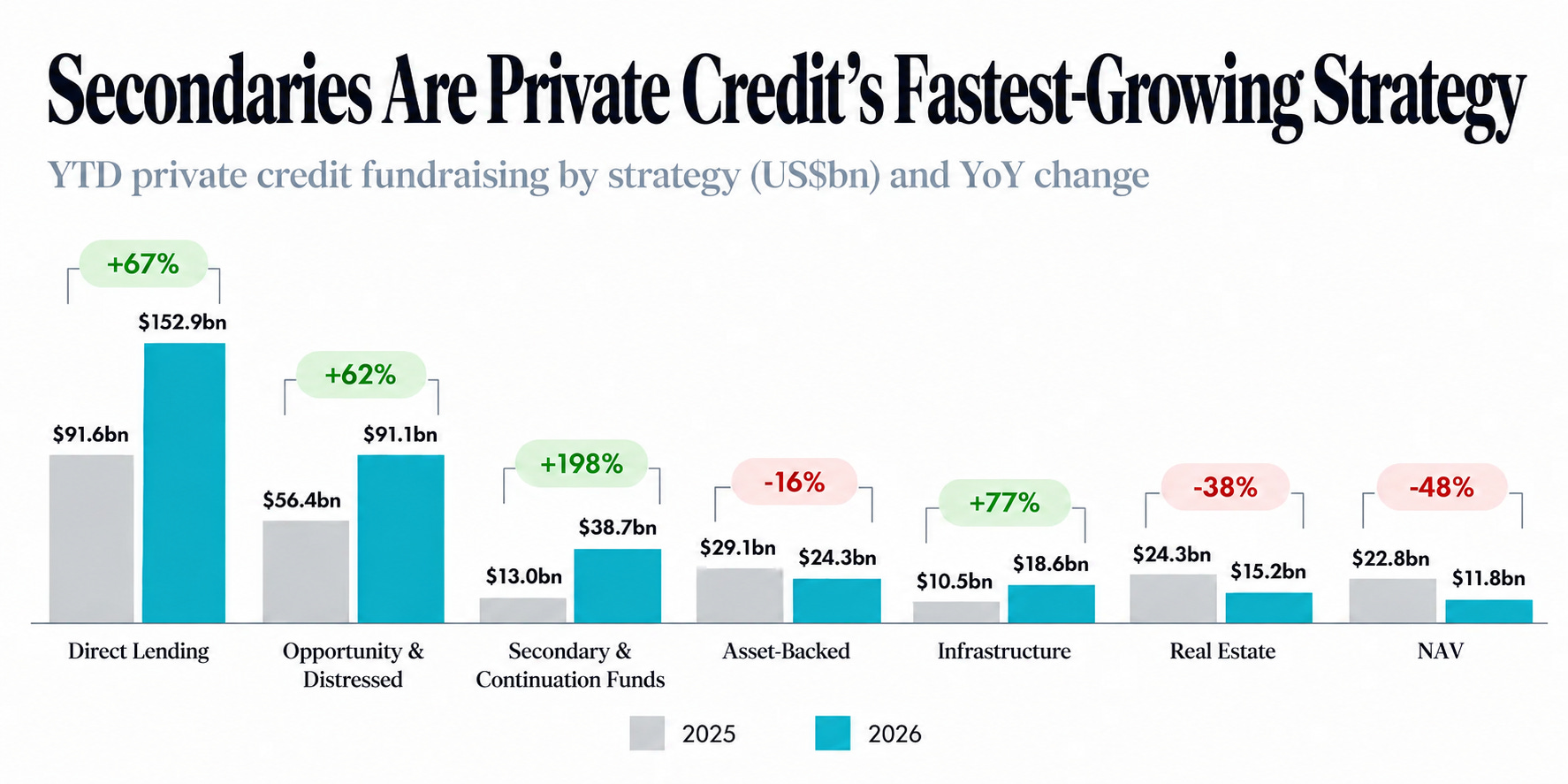
More credit secondaries funds have closed this year than in the previous three years combined.
Ares’s $7.1 billion Credit Secondaries fund is in a league of its own, at more than twice the size of its nearest rival. Pressure to generate DPI has fuelled a sharp increase in continuation fund fundraising, with Crescent Capital’s $3.2 billion the largest example this year.
Despite the rapid growth, credit secondaries remain a small part of the overall direct lending market, as Carlyle has highlighted. Evercore expects that gap to narrow as the strategy continues to scale over the next several years.
Direct lending remains the largest fundraising strategy, but growth is increasingly concentrated at the top end of the market. Six of the ten largest Q3 funds were direct lending vehicles, while the number of sub-$1 billion funds fell 40% year on year.
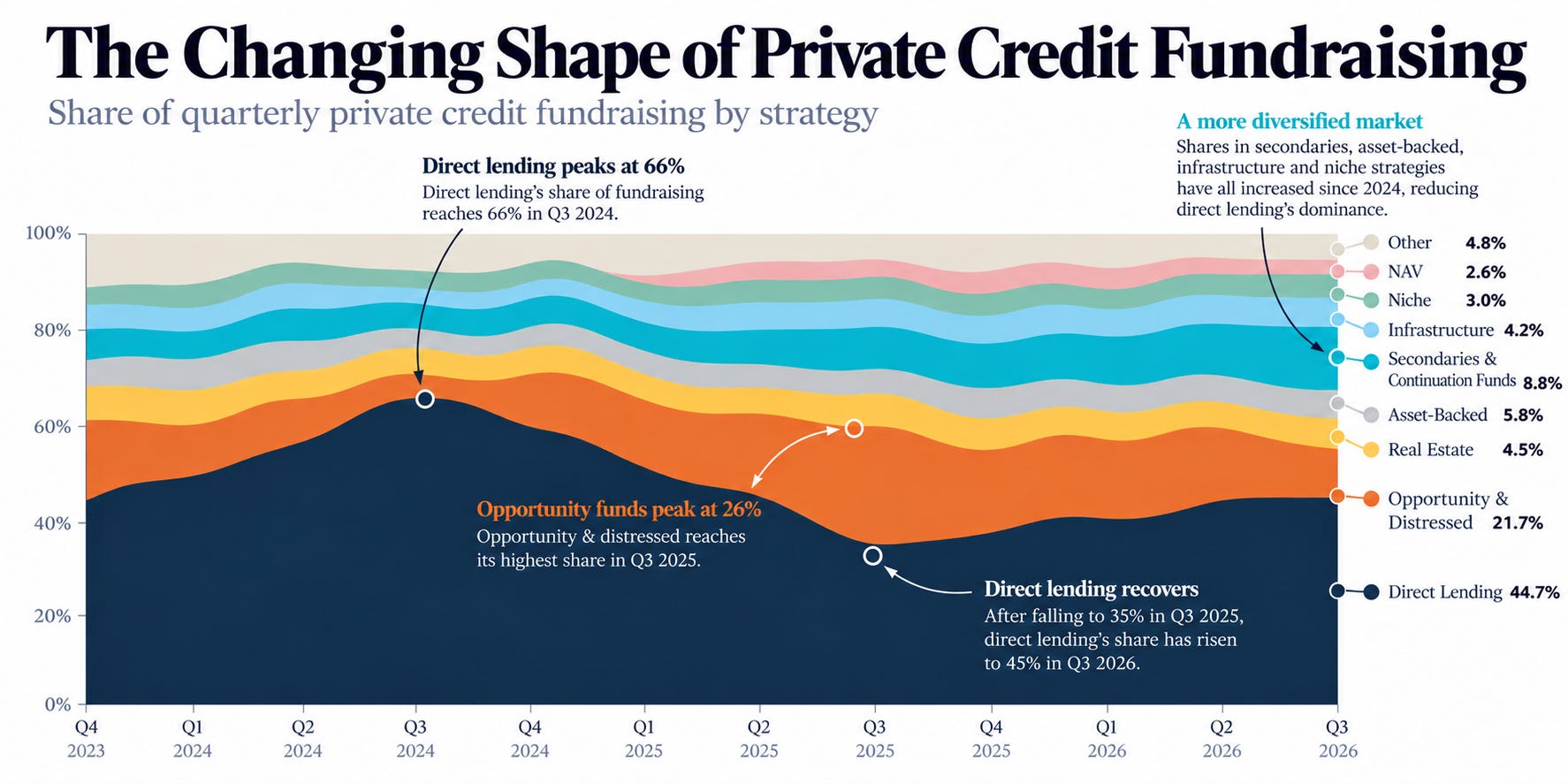
The Changing Shape of Private Credit Fundraising
This isn’t a Q3 update, but it’s a good excuse to use one of these grey boxes.
Looking back at the fundraising mix since I started tracking the market highlights just how much private credit has changed:
Direct lending has recovered from its Q3 2025 low, but remains well below its Q3 2024 peak.
Investor appetite for opportunity funds appears to be cooling.
Secondary funds have grown every quarter without fail.
It Feels Like There’s Indigestion
Hyperscaler data center spreads have widened pretty meaningfully just over the last couple of weeks. That stands in contrast to the broader IG markets, which, again, still pretty much remain at their tight. And we’ve had year-to-date this flurry of jumbo deals. I saw a note a day or two ago. I think we’ve had more $25-plus billion deals year-to-date than the last five or six years combined. And so, it does. It feels like there’s indigestion.
No market update in 2026 would be complete without mentioning AI and data centers.
As Apollo put it, the AI Buildout Is Reshaping Credit Markets.
For anyone trying to make sense of the scale and the risks of the boom, the latest In the Gaps by Ares is the best white paper I’ve read on it.
🏆 Nick’s Funds of the Quarter
🇪🇺 ICG’s $14 billion Europe Fund IX
ICG announced a final close of ~$14 billion for its Europe Fund IX. The flagship European Corporate strategy will target 15-20 investments in Western Europe across middle and upper-middle market companies, with deal sizes ranging from EUR 250 million to EUR 1 billion. The investments are generally industry-agnostic and will include a blend of debt and equity-like investments.
💻 Claret Capital’s $670 million Fund IV
Claret Capital, a London-based manager, announced the final close of its Fund IV. The fund invests in technology and life science businesses across Europe and globally.
🚜 Homestead Capital’s $350 million US Agriculture Fund
Homestead Capital, a San Francisco-based investment manager specialising in US agriculture, announced the first close of its inaugural commingled private credit strategy. The fund originates senior secured loans to agricultural borrowers across the United States, collateralised primarily by farmland and other agricultural assets, addressing financing needs underserved by traditional agricultural lenders.
This newsletter is for educational or entertainment purposes only. It should not be taken as investment advice.